cat -- '2026-06-25-security.md' Security News
SecurityWeek
Latest cybersecurity news
Cisco SD-WAN Zero-Day Exploited Months Before Patching - June 25, 2026
CVE-2026-20245, the 7th Cisco SD-WAN vulnerability exploited in 2026, was used for months prior to its disclosure and patching.
The post Cisco SD-WAN Zero-Day Exploited Months Before Patching appeared first on SecurityWeek.
The Hacker News
Cybersecurity news and insights
Cisco Catalyst SD-WAN Zero-Day CVE-2026-20245 Exploited to Gain Root Access - June 25, 2026
An unknown threat actor exploited a recently disclosed high-severity security flaw impacting Cisco Catalyst SD-WAN as a zero-day at least two months before it was publicly disclosed, according to new findings from Google-owned Mandiant.
The vulnerability, tracked as CVE-2026-20245 (CVSS score: 7.8), allows an authenticated, local attacker to execute arbitrary commands with elevated privileges
SecurityWeek
Latest cybersecurity news
When Information Becomes the Attack Surface – Understanding AI Agent Traps - June 24, 2026
From hidden content injections to cognitive state poisoning, attackers are turning trusted data sources into traps for autonomous AI.
The post When Information Becomes the Attack Surface – Understanding AI Agent Traps appeared first on SecurityWeek.
The Hacker News
Cybersecurity news and insights
CISA Warns Critical Lantronix EDS5000 Flaw Is Being Actively Exploited - June 24, 2026
The U.S. Cybersecurity and Infrastructure Security Agency (CISA) on Tuesday warned of active exploitation of a critical security flaw impacting Lantronix EDS5000 Series devices, urging Federal Civilian Executive Branch (FCEB) agencies to apply the fixes by June 26, 2026.
The vulnerability in question is CVE-2025-67038 (CVSS score: 9.8), a code injection flaw that could result in the execution
Amadey and StealC Malware Network Disrupted, 27M Stolen Credentials Recovered - June 24, 2026
A coordinated law enforcement operation, in partnership with private sector companies, including Bitdefender, Bitsight, ESET, and Microsoft, has resulted in the takedown of criminal infrastructure powering Amadey and StealC.
“The main common goal was to disrupt the ‘assembly lines’ cybercriminals use to launch ransomware, financial fraud, and attacks on critical infrastructure,” Europol said in
SecurityWeek
Latest cybersecurity news
Microsoft and Allies Smash Shared Infrastructure of Amadey and StealC Malware - June 24, 2026
Hundreds of C&C servers were disrupted in an operation involving law enforcement and several cybersecurity companies.
The post Microsoft and Allies Smash Shared Infrastructure of Amadey and StealC Malware appeared first on SecurityWeek.
Exclusive: Meet AIVEX, a New Triage Model Built to Reduce Supply Chain Threat and Risk - June 24, 2026
The new framework seeks to help security teams identify which software supply chain vulnerabilities pose the greatest operational, safety, and business risks in AI-driven environments.
The post Exclusive: Meet AIVEX, a New Triage Model Built to Reduce Supply Chain Threat and Risk appeared first on SecurityWeek.
macOS Weaknesses Chained to Silently Disable Endpoint Security Agents - June 24, 2026
A standard non-admin account is sufficient to conduct an attack that exploits legitimate OS behavior rather than software vulnerabilities.
The post macOS Weaknesses Chained to Silently Disable Endpoint Security Agents appeared first on SecurityWeek.
The Hacker News
Cybersecurity news and insights
Cordyceps CI/CD Flaws Expose 300+ GitHub Repositories to Supply-Chain Attacks - June 24, 2026
Cybersecurity researchers have flagged a new class of CI/CD workflow weakness that allows attackers to hijack workflows and compromise open-source supply chains.
The “critical exploitable pattern” has been codenamed Cordyceps by Novee Security. The issue can allow full attacker control of repositories at dozens of the largest organizations worldwide, including Microsoft, Google, Apache, and
SecurityWeek
Latest cybersecurity news
Critical Ubiquiti Vulnerabilities in Attackers’ Crosshairs - June 24, 2026
The flaws allow remote, unauthenticated attackers to make system changes, access underlying accounts, and inject commands.
The post Critical Ubiquiti Vulnerabilities in Attackers’ Crosshairs appeared first on SecurityWeek.
Agentic AI Security: Wrong Context, Wrong Decisions at Machine Speed - June 24, 2026
Context is the central plank of AI in general, and agentic AI in particular. If an AI system doesn’t have the correct context, it cannot make the correct decisions.
The post Agentic AI Security: Wrong Context, Wrong Decisions at Machine Speed appeared first on SecurityWeek.
The Hacker News
Cybersecurity news and insights
Dawn of the Apex Agentic Adversary - June 24, 2026
We are standing at the end of an era we never thought to mourn: the era of human-speed threats.
For years, cybersecurity moved to a rhythm organizations could follow. A researcher found a bug, a CVE was cataloged, a vendor navigated a patch cycle, and weeks or even months later, a fix was deployed. In this era, dwell time was measured in days, sometimes weeks. We are now approaching an
Schneier on Security
Security news and analysis by Bruce Schneier
Embedding Forbidden Text in Spyware to Discourage AI Analysis - June 24, 2026
At least one malware developer is adding text about nuclear and biological weapons to their spyware, in an effort to stop automatic AI analysis.
The _index.js payload begins with a large JavaScript block comment containing fake system instructions and policy-triggering content. Because it is inside a comment, it does not affect JavaScript execution. The runtime skips it. The real malware begins after the comment with a try{eval(…)} wrapper around a large character-code array and a ROT-style substitution function.
This header appears designed for AI-mediated analysis, not for Node, Bun, or Python. It attempts to derail scanners or analyst copilots that feed the beginning of a file to a language model without clearly isolating the content as untrusted data. In weak pipelines, this can cause refusal behavior, prompt confusion, context pollution, or premature classification before the scanner reaches the actual malware...
SecurityWeek
Latest cybersecurity news
Exploitable CI/CD Vulnerabilities Expose Millions of Repositories to Hijacking - June 24, 2026
The security defects allow unauthenticated users to take control of the open source software supply chain.
The post Exploitable CI/CD Vulnerabilities Expose Millions of Repositories to Hijacking appeared first on SecurityWeek.
The Hacker News
Cybersecurity news and insights
DoJ Seizes Huione Cloud Account Tied to Cyber Scam Money Laundering - June 24, 2026
The U.S. Department of Justice (DoJ) on Tuesday announced the seizure of a cloud computing account put to use by subsidiaries of Cambodia-based corporate conglomerate HuiOne Group, as the Treasury unveiled fresh sanctions against nine individuals and 26 entities linked to Prince Group.
“These subsidiaries are alleged to have assisted individuals and organizations in transferring proceeds of
Cisco Unified CM Flaw Exploited After PoC Reveals File-Write Path to Root - June 24, 2026
Threat actors have begun to exploit a recently disclosed critical security flaw impacting Cisco Unified Communications Manager (Unified CM) and Unified Communications Manager Session Management Edition (Unified CM SME).
The vulnerability, tracked as CVE-2026-20230 (CVSS score: 8.6), is a case of improper input validation for specific HTTP requests that could allow an unauthenticated, remote
Fake AI Agent Skill Passed Security Scans and Reportedly Reached 26,000 Agents - June 23, 2026
Security firm AIR built a fake AI agent skill, pushed it through a popular skill marketplace and an Instagram ad, and says it reached roughly 26,000 agents, including some on corporate accounts.
Every skill security scanner the firm tested it against marked it safe. The payload was harmless by design: it collected the user’s email address and did nothing else.
The point was to show
Schneier on Security
Security news and analysis by Bruce Schneier
Anthropic’s Fable 5 Model Jailbroken Within Days - June 23, 2026
Fable 5 is the supposed safe version of Anthropic’s Mythos Preview, with guardrails to ensure that it can’t be used to create cyberattacks.
Well, that restriction was bypassed within days.
Trail of Bits Blog
Security research and insights from Trail of Bits
Introducing Patch the Planet - June 22, 2026
What happens when you clear dozens of Trail of Bits engineers’ schedules, pair them with every open-source maintainer they can contact, and unleash the latest frontier models like GPT-5.5-Cyber on critical open-source targets? Thanks to our partnership with OpenAI and its Daybreak initiative, we can report that the impact is hundreds of discovered bugs, 64 pull requests, and 51 issues filed across 19 projects (with many more still undergoing coordinated disclosure). That was just the first week of Patch the Planet.
Frontier models like GPT-5.5-Cyber are producing a firehose of security findings, and already-stretched maintainers must sift through all of it to separate real vulnerabilities from plausible-sounding false positives. Patch the Planet is different: with our experts orchestrating and triaging findings, we handle the work of fixing and hardening the code alongside the people who maintain it.
The first week of Patch the Planet covered 19 projects across cryptography, networking, language infrastructure, and software supply chain. Among these 19 projects were cURL, NATS, pyca, Sigstore, aiohttp, the Go project, freenginx, Python and python.org, urllib3, PyPI, SimpleX, Valkey, and RustCrypto. Over 30 projects have joined the initiative so far, and we’re rapidly expanding it to include more; if you maintain an open-source project, apply to join!

Anyone can file an issue, flex, and walk away. We showed up with the patches: 37 are already merged, and many more are in flight. These merges go beyond just fixing bugs: we’re adding new tests and fuzzing harnesses, CI security scanning, supply-chain tooling, correctness fixes, and features maintainers had been meaning to get to. The goal of Patch the Planet is to leave essential open-source projects measurably better off.
We brought patches, not just bug reports
We’re reporting public findings on GitHub, including 64 total pull requests. We also filed 51 issues, 19 of which are already closed with a fix. This public tally undercounts the work, since several projects take reports through private channels like HackerOne, GitHub security advisories, mailing lists, and private forks, and most of these have not been released publicly yet.
What’s in those pull requests matters more than the count. At python.org, we added a CI workflow built on zizmor, an open-source GitHub Actions static analyzer, fixed all of the issues it flagged, and integrated it into their CI. In RustCrypto, we contributed correctness fixes to the big-integer library that higher-level cryptography is built on, alongside genuine feature work in review: serde encoding support and HPKE DHKEM suite IDs. Other patches were plain engineering help: storage-accounting and service-restart fixes in SimpleX, a clearer admin-quarantine confirmation in PyPI’s Warehouse, and supply-chain improvements like SBOM sidecars for Python’s Windows artifacts. We will also be upstreaming many testing improvements and new testing campaigns. Arguably, our best contributions are not even bug or security fixes.
Keeping track of all of this is a bot we call Patchy. Patchy monitors every project, posts each new finding and merged patch to our Slack, and, for reasons we consider scientifically sound, reintroduces the common use of goblins, gremlins, and assorted creatures. Here’s Patchy’s description of an issue that has been patched:
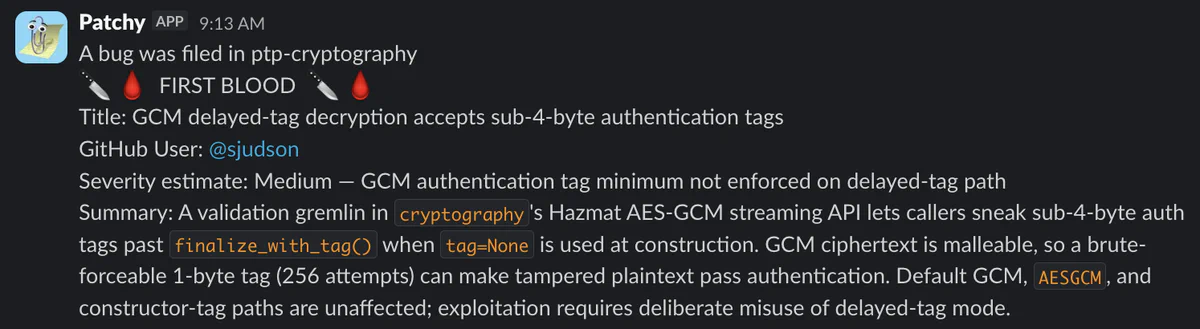
When a patch lands, Patchy celebrates with a triumphant PATCHY HAPPY. Making Patchy happy is really what drives us.

A few highlights from the week
The week produced more than we can fit in this post, but here are some quick highlights.
A fuzzing lab built in a day. Given a narrow goal (find remotely exploitable bugs) and no instructions on how, GPT-5.5-Cyber decided that reading the source of one of the most-reviewed C libraries in existence was a poor use of tokens. Instead, it stood up a full fuzzing lab in under a day: sanitizer and variant builds, a seed corpus drawn from existing tests, and harnesses across a dozen entry points. Instead of simply fuzzing exposed APIs, it successfully built a harness that injected operating system backpressure to identify novel issues by reaching previously unexplored buggy states. We estimate all of that effort likely would’ve taken one of our fuzzing experts two to three weeks to do manually. Just as important, it showed judgment about what to test, what to report (and not report), and where to find higher-impact findings. We’ll publish the full details in a standalone field report.
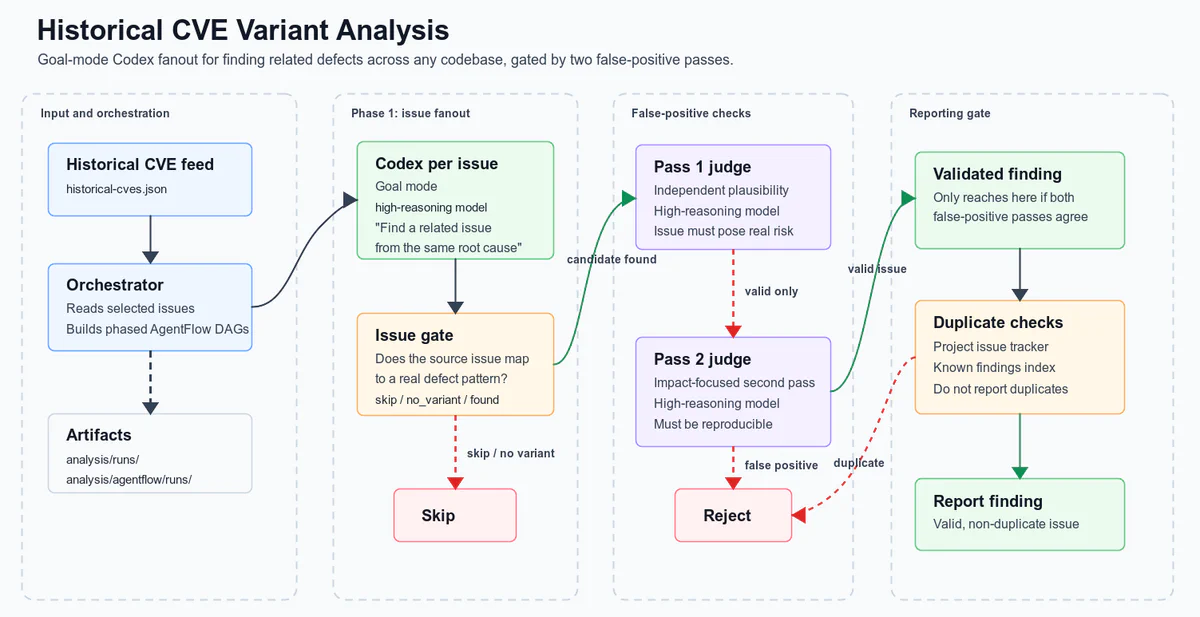
A pipeline for variant testing historical CVEs built in a day. Codex was also adept at building simple but effective pipelines, such as the CVE variant analysis pipeline shown below. Codex’s /goal feature combined with frontier models like GPT-5.5-Cyber for this type of variant analysis produced novel issues with almost exclusively high-signal output.
A release-pipeline improvement at python.org. We reported multiple security issues for python.org, including some issues closing a legacy-API authorization gap. But we’re most proud of the work that produced long-term improvements to python.org’s release infrastructure: the new zizmor CI scanning, tightened release-file and metadata validation, deletion scoping fixed so bulk operations can’t reach beyond their target, and release-tooling patches in review that quote remote command arguments, fail safely on partial uploads, and add SBOM sidecars.
The aiohttp maintainers fixed their issues almost immediately. We privately reported a cluster of issues across aiohttp’s client and server paths, including cookies that could regain broader scope after a save and reload, digest credentials that could answer a challenge from the wrong origin, and resource limits that ran after attacker-controlled buffering rather than before. The maintainers authored and merged all eight fixes within hours, seven of them inside a single five-hour window. We were impressed and appreciate the maintainers’ prompt and collaborative work on these issues!
Differentially testing major cryptographic libraries against each other. Many of our projects implement the same logic, protocols, and algorithms. In particular, multiple projects implement the same cryptographic algorithms and standards like X.509 certificates. Therefore, we used Codex to point these projects at each other, and identify any relevant behavioral differences. This proved to be a high-signal approach that uncovered several issues, including this AES-GCM issue in PyCA and several X.509 issues, which we plan to upstream to x509-limbo.
Finding the bugs is now the easy part
If it wasn’t already clear from the last several months of security news, this week makes one thing clear: the expensive part of security work has moved. Arming Codex with fuzzing campaigns, variant analysis, differential testing, agentic searching, and similar techniques produces real vulnerabilities and compresses weeks or months of manual effort into hours. The advantage is no longer in finding bugs, but everything after: confirming a finding, getting its severity right, writing a patch a maintainer will accept, hardening the surrounding code, making long-term improvements to prevent similar issues in the future, and coordinating a disclosure. That is the work that floods of AI-generated reports threaten to bury.
Guidance for maintainers
If you’re a maintainer managing an unsustainable number of AI-generated bug reports, the core challenges you need to solve are deduplication, false-positive filtering, and severity correction.
Deduplication is the easiest problem to solve technically. Even simple AI-based tools that compare new reports against open issues perform well, especially when grounded in affected code lines. Automating this step eliminates most of the noise.
False-positive filtering and severity correction are harder, but they can be managed. Without explicit guidance, models default to rating everything as critical.

Generic approaches like our fp-check tool help, but only to a point. The best improvements require project-specific documentation, threat models, and severity criteria. PyCA’s security documentation, for example, was dramatically effective at reducing false positives in our bug candidates. Files like AGENTS.md that explicitly tell models which documentation to consult produced the most consistent and effective results. If security researchers are armed with this documentation, especially AGENTS.md for AI-based research, more noise will be filtered out before reaching the maintainers.
What’s next and how to get involved
This was just our first week. Over 30 projects have committed to join Patch the Planet, with a growing waitlist. As more findings clear coordinated disclosure, we’ll publish more results and deeper field reports, including full fuzzing lab details, the variant-analysis and differential-testing pipelines, and the tooling we’re building to help maintainers triage AI-generated reports themselves. Our Patch the Planet gist contains the full public list of our week one output.

If you maintain a critical open-source project and want this kind of help, you can apply to join Patch the Planet.