cat -- '2026-07-31-security.md' Security News
SecurityWeek
Latest cybersecurity news
Critical Code Execution Vulnerability Patched in TeamCity - July 31, 2026
Tracked as CVE-2026-63077, the security defect can be exploited without authentication via the agent polling protocol.
The post Critical Code Execution Vulnerability Patched in TeamCity appeared first on SecurityWeek.
CISA Urges Water Sector to Protect OT After Coordinated Attacks on PLCs - July 30, 2026
CISA is urging water and wastewater utilities to lock down internet-exposed controllers, days after intrusions hit dozens of Minnesota systems.
The post CISA Urges Water Sector to Protect OT After Coordinated Attacks on PLCs appeared first on SecurityWeek.
Schneier on Security
Security news and analysis by Bruce Schneier
American Being Prosecuted for Wiping His Phone Before Handing It Over to Border Officials - July 30, 2026
He’s being prosecuted for giving border officials a code that wiped his phone:
The case centers on a feature included in GrapheneOS, a custom Android operating system that runs in place of the software on most modern Google Pixel devices. Tunick’s attorneys confirmed GrapheneOS was running on his phone.
The software feature allows the device owner to set a passcode that deliberately wipes the contents of that device if entered instead of the user’s unlock passcode.
Tunick’s case also raises ongoing questions about what constitutional rights can be invoked at the border, which the U.S. government has long asserted is not U.S. soil until a person is authorized to enter...
The Hacker News
Cybersecurity news and insights
ThreatsDay: AI-Powered Hacking, 370 Chrome Flaws, SonicWall Attacks, DNS Hijacking + 22 More Stories - July 30, 2026
A lot of security still comes down to trusting the wrong screen.
This week, that screen might be a login page, an install guide, a recruiter call, or a familiar service behaving slightly wrong. Behind it: reused credentials, exposed systems, quiet loaders, abused trust, and exploit paths that should have been harder.
Some defenses improved. The loose parts still got found first. Anyway,
SecurityWeek
Latest cybersecurity news
DataBahn Raises $40 Million for Agentic Data Pipeline Management - July 30, 2026
The company will accelerate investments in R&D and product innovation to expand its agentic data control plane.
The post DataBahn Raises $40 Million for Agentic Data Pipeline Management appeared first on SecurityWeek.
The Hacker News
Cybersecurity news and insights
Azure Cosmos DB Flaw Exposed Platform-Wide Key That Could Access Any Database - July 30, 2026
A now-patched vulnerability in Azure Cosmos DB could have let an attacker escape the service’s Gremlin query sandbox and obtain full read and write access to databases across customer tenants, according to Wiz.
Wiz, which codenamed the chain CosmosEscape, said the exploit chain began with a crafted query against a Gremlin database controlled by the attacker. From there, code execution on a
SecurityWeek
Latest cybersecurity news
Discern Security Raises $13 Million in Series A Funding - July 30, 2026
The company will invest in accelerating the development and adoption of its agentic platform.
The post Discern Security Raises $13 Million in Series A Funding appeared first on SecurityWeek.
Onyx Security Raises $113 Million to Control AI Agents in the Enterprise - July 30, 2026
The Series B funding round brings the total raised by Onyx Security to $153 million.
The post Onyx Security Raises $113 Million to Control AI Agents in the Enterprise appeared first on SecurityWeek.
‘DangleGeddon’: AI Could Weaponize Forgotten DNS Records at Global Scale - July 30, 2026
Researchers warn that AI could turn dangling DNS takeovers into a nation-state weapon capable of disrupting governments, banks and global supply chains.
The post ‘DangleGeddon’: AI Could Weaponize Forgotten DNS Records at Global Scale appeared first on SecurityWeek.
The Hacker News
Cybersecurity news and insights
Microsoft Copilot for Word Can Copy Hidden Prompts Into New Documents - July 30, 2026
Hidden instructions in a Word document can make Microsoft 365 Copilot rewrite figures in a report, then copy the same instructions into the finished file. Håkon Måløy disclosed the technique on July 28, 144 days after reporting it to Microsoft.
In his proof of concept, the internally generated file triggered the same behavior when it was used in a second Copilot drafting session.
Måløy’s
The Network Has Become the Control Plane for AI Security - July 30, 2026
Network firewalls are the workhorses of modern cybersecurity. They are trusted to protect the network, blocking malicious traffic and preventing intrusions and breaches. And for decades, network security teams have built controls around a relatively stable model: users connect to applications, applications exchange data, and security tools inspect packets, protocols, and destinations. Firewalls
Schneier on Security
Security news and analysis by Bruce Schneier
Should You Use AI for a Task? Here’s a Simple Way to Decide - July 30, 2026
This essay originally appeared in The Guardian.
I teach public policy at the Harvard Kennedy School and the Munk School at the University of Toronto. And it will come as no surprise to you that my students regularly use AI to complete their writing assignments. Doing so is a waste of their tuition money. But if their entire career is going to include AI writing assistants, why shouldn’t they embrace their future?
The best way I’ve found to explain the dilemma comes from the AI researcher Daniel Meissler: it’s the difference between work and the gym...
Trail of Bits Blog
Security research and insights from Trail of Bits
Building secure Uniswap v4 hooks - July 30, 2026
Uniswap v4 hooks let developers add custom behavior to pools, including dynamic fees, custom accounting, and external integrations. This flexibility moves some security responsibilities into application and hook code.
The Cork and Bunni exploits are two app-level incidents that show what can go wrong in that code. Together, they account for more than $20M in losses. Neither incident stemmed from a flaw in the Uniswap v4 core protocol or the PoolManager; both arose from application-specific authorization and accounting logic built around hooks.
After analyzing dozens of findings from Trail of Bits audits (including our Uniswap v4-core security review), public reports from other firms, and the Solodit database, I’ve identified seven recurring failure patterns in application and hook code, including missing caller checks and accounting bugs that still satisfy the PoolManager’s settlement invariant. Builders can use these patterns as a secure-development checklist; auditors can use them to focus their review.
What the PoolManager guarantees
If you’re familiar with Uniswap v3, where each pool was a separate contract, v4 inverts the model. All pool state now lives in a singleton PoolManager contract, with each pool represented in its storage. Uniswap v4 adds hooks: independent contracts that execute custom logic at specific points in the swap and liquidity lifecycle.
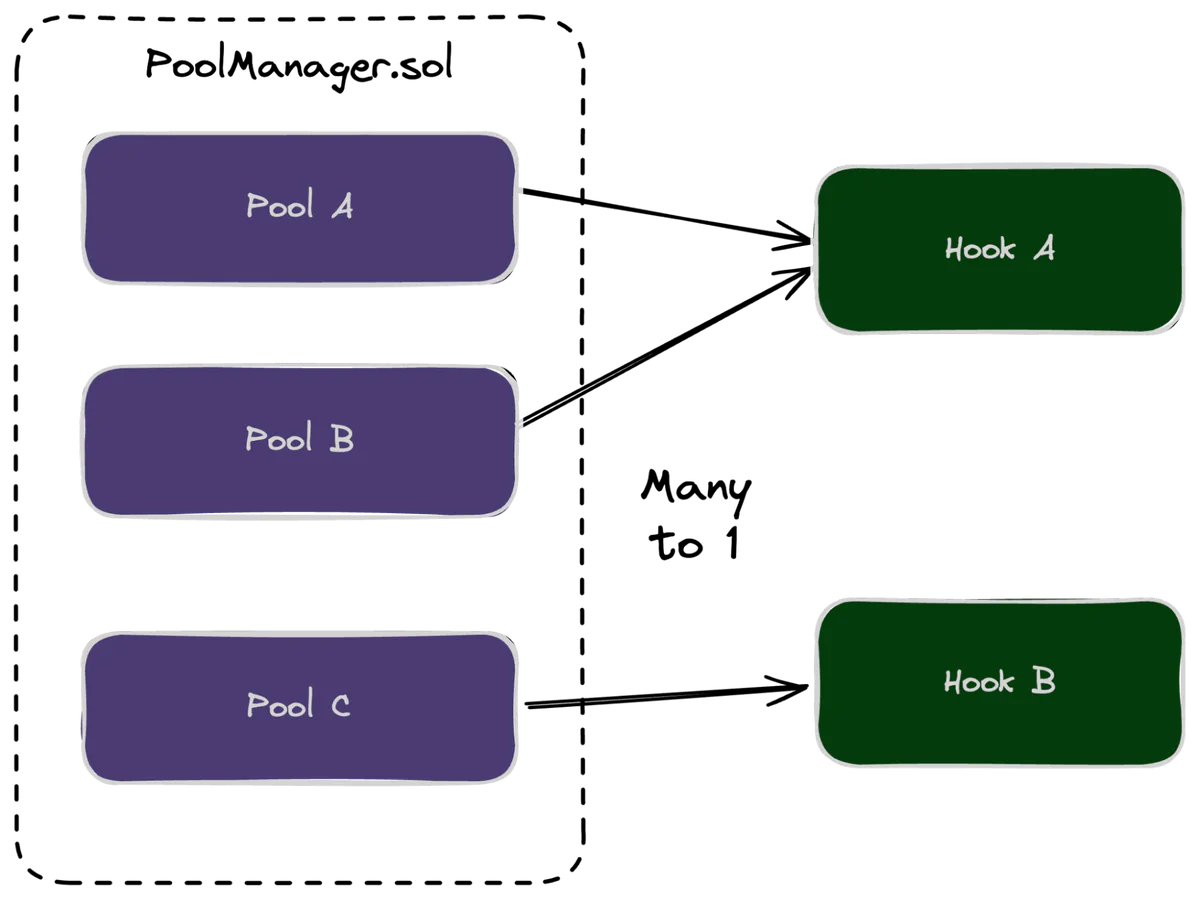
Here’s what a pool looks like in v4:
struct PoolKey {
 Currency currency0;
 Currency currency1;
 uint24 fee;
 int24 tickSpacing;
 IHooks hooks;
}Notice that the hook address (IHooks hooks;) is part of the pool’s identity. If you change any of these fields, you’re talking to a different pool. This matters because trusting the wrong PoolKey means trusting the wrong pool.
v4 also introduces a session-based model that works like a flash loan. Your contract calls unlock() on the PoolManager, which triggers a callback into your code. At the end, the PoolManager checks that no unsettled currency deltas remain:
function unlock(bytes calldata data) external returns (bytes memory result) {
 Lock.unlock();
 // ... callback execution happens here ...
 if (NonzeroDeltaCount.read() != 0) revert CurrencyNotSettled();
 Lock.lock();
}
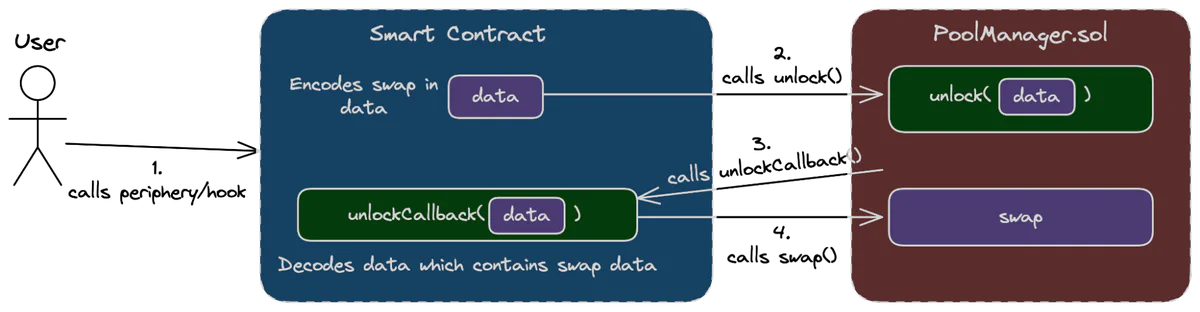
The PoolManager enforces v4’s protocol mechanics, including pool initialization rules, swap and liquidity math, hook-callback sequencing, and end-of-session settlement. Hook developers are responsible for validating the application-specific assumptions their hooks add.
Each hook must decide:
- Who can call its privileged paths
- Which pools are legitimate
- How custom balances and deltas should be accounted for
- Whether external integrations can fail or reenter safely
1. Anyone can call your hook
Hook callbacks are external functions on your contract. If you don’t check the caller, an attacker can call those callbacks directly with malicious parameters. A loose unlockCallback path can also reach internal actions that should never be callable.
The fix: use BaseHook for hook entrypoints and SafeCallback for unlockCallback. Together, they enforce caller checks on the callback paths they cover:
modifier onlyPoolManager() {
 if (msg.sender != address(poolManager))
 revert NotPoolManager();
 _;
}Add an equivalent caller check only on paths those contracts don’t cover.
Real-world example: The Cork exploit (~$12M, May 2025) shows why this check matters. Cork let data from an untrusted path reach hook logic that affected redemptions. That access-control gap, combined with a pricing issue elsewhere in the protocol, gave the attacker a way to drain funds.
2. Treating any pool as legitimate
Pool creation through the PoolManager is permissionless by default. Unless your hook restricts initialization in beforeInitialize, anyone can create a pool with your hook address attached. If your hook trusts a user-supplied PoolKey without validation, an attacker can route your logic through a malicious pool with currencies and parameters they choose.
An attacker-created pool presents two immediate risks. First, if your hook stores per-pool data keyed by PoolId, the new pool gets its own mapping slot. The attacker can influence values written through activity in that pool, and later accounting paths may treat those values as trusted. Second, currency0 and currency1 are attacker-chosen currencies. If either is an ERC-20, token interactions can trigger malicious behavior or reenter other hook functions mid-flow.
The fix: bind your hook to canonical pools during deployment or trusted configuration, or maintain a strict allowlist. Re-check the derived PoolId on every user-controlled path:
// Pseudocode for pool binding
PoolId poolId = key.toId();
if (!allowedPools[poolId]) revert InvalidPool();Real-world example: In Semantic Layer’s SVFHook finding, the addLiquidity function lets callers specify the PoolKey. An attacker could route deposits through a custom WETH/SVF pool with a malicious hook and earn points at a lower cost than intended.
3. Custom accounting leaks value
In v4, a delta is a signed currency-balance change owed to or from the PoolManager. Once your hook touches deltas, a wrong sign, a rounding error, or mixing balance buckets can silently leak value. These bugs are subtle because settlement only checks that the session’s currency deltas resolve; it does not validate the hook’s internal accounting. A hook’s accounting can still be wrong even when settlement succeeds.
Return-delta hooks can move beyond fee bookkeeping. If a BeforeSwapDelta consumes the user’s entire specified amount, the PoolManager has no amount left for its concentrated-liquidity swap; the hook supplies the trade instead. This is often called a NoOp swap. Treat that hook as a custom AMM: test conservation, price bounds, rounding, and returned deltas against real balances.
Dynamic fees are also price-sensitive. A dynamic-fee pool can accept a per-swap fee override from beforeSwap, and its hook can update the stored LP fee. Bound every fee, limit how quickly privileged changes can move it, and do not derive it directly from inputs an attacker can cheaply manipulate.
For hooks that move value, test at least these three accounting invariants:
- No user receives output that the accounting did not charge for.
- A same-transaction round trip cannot create value from accounting alone.
- Internal accounting matches actual asset balances.
Those invariants must also hold for the tokens the hook handles. Fee-on-transfer tokens can make the amount received smaller than the amount sent; rebasing tokens can change balances without a transfer; callback-enabled tokens can reenter; and pausable or blacklistable tokens can block settlement. State which behaviors you support and test accounting against observed balance changes.
The fix: keep LP funds, fees, and incentives in separate buckets. Label every balance and delta, including who owns it, and who can move it.
Real-world example: The Bunni exploit ($8.4M, September 2025) was a rounding bug in BunniHook’s idle-balance accounting. The attacker pushed a pool’s price tick with a flash loan, then made 44 tiny withdrawals that each shrank the active balance disproportionately to the shares burned, eventually extracting profit from the affected pools. Each transaction satisfied the PoolManager’s settlement invariant because the bug was in BunniHook’s internal accounting.
4. Right logic, wrong hook
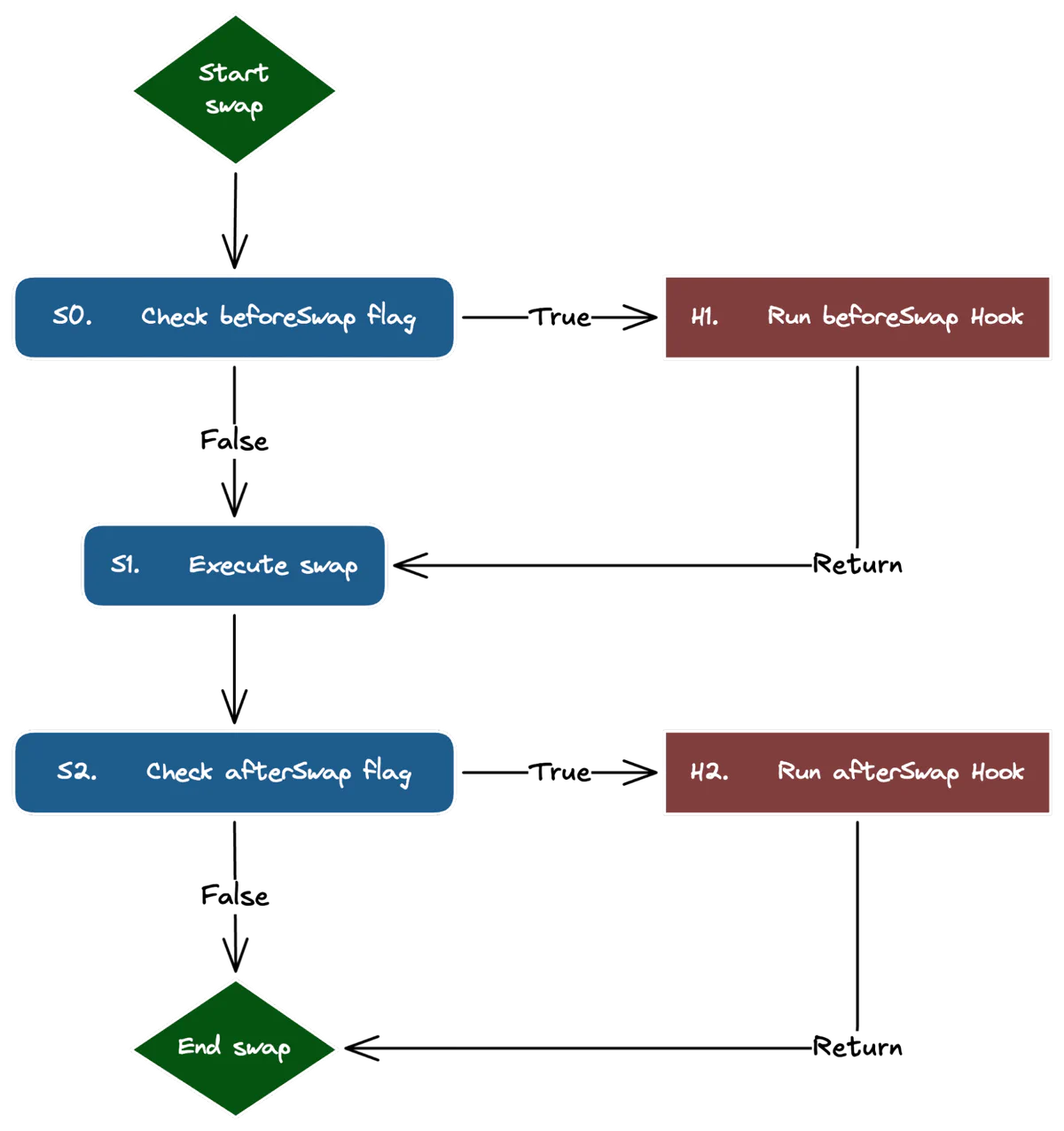
The beforeSwap hook executes with pre-swap state, but the afterSwap hook sees post-swap state. Code that’s correct in one hook can be unsafe in another.
The same timing problem affects liquidity callbacks. In this LiquidityPenaltyHook finding, a JIT-liquidity penalty was computed during afterRemoveLiquidity, but a user could first make a tiny liquidity increase that collected the fees separately. By the time removal ran, the hook saw no fees left to penalize.
In our hook audits, we’ve repeatedly observed developers put logic that needs the final swap result in beforeSwap instead of afterSwap. The code looks correct in isolation, but it’s operating on stale data.
The fix: verify your logic is in the correct hook for the state it needs.
5. Address bits are part of the API
In v4, the hook address itself encodes which hook functions the PoolManager will call. This design makes the deployed address part of a hook’s API, so developers must keep its permission bits in sync with the functions they implement.
function hasPermission(IHooks self, uint160 flag) internal pure returns (bool) {
 return uint160(address(self)) & flag != 0;
}Three permission mismatches can cause problems:
- Callback bit set + callback missing → transaction reverts.
- Callback implemented + callback bit missing → PoolManager does not call it.
- Return-delta bit missing → PoolManager may call the callback but treat its returned delta as zero.
For example, if the afterSwapReturnDelta bit is missing, your hook might record a fee even though the PoolManager ignored the returned delta.
Address bits do not make the hook’s behavior immutable. If a pool’s hook address points to a proxy, the permission bits stay fixed while an upgrade can change the code reached through that address. Review the upgrade admin, delay, storage layout, and implementation checks as part of the hook’s security boundary. Prefer immutable, versioned deployments when possible.
The fix: inherit from BaseHook and keep getHookPermissions() in sync with the callbacks and return deltas your hook actually uses. BaseHook validates that the deployed address bits match those declared permissions.
Real-world example: In the Sorella Angstrom finding, the hook returned a non-zero delta for the dynamic protocol fee, but hook-config.sol did not encode the afterSwapReturnDelta permission. The PoolManager wasn’t authorized to settle the delta, so every swap reverted with CurrencyNotSettled() once the fee was enabled.
6. Hook failures can block pool actions
Hook callbacks execute in the same transaction as the pool action. If reward distribution, dust cleanup, or other non-essential code reverts inside an afterRemoveLiquidity callback, users cannot exit their positions. The same applies to swaps when non-essential code reverts inside afterSwap. The PoolManager preserves atomic execution by reverting the parent action, so hook developers must keep optional logic from blocking core user flows.
Required external reads can cause the same denial of service. If a price feed rejects stale data, a lending protocol pauses, or another dependency reverts, the callback can revert the user’s swap or withdrawal. For each dependency, decide which paths must fail closed and which can degrade without blocking safe exits. Never silently use stale pricing data.
External calls are not the only source of failure. In our hook audits, we’ve seen happy-path accounting block withdrawals because of a zero balance, decimal mismatch, or missing reward token.
The fix: keep non-essential code out of the main user flow. Wrap optional external calls in try/catch, or move optional logic to a separate function users can call after exiting. For safety-critical dependencies, validate freshness and bounds, and provide an explicit exit-safe fallback when the design permits one.
7. State can change during a callback sequence
When enabled, beforeSwap and afterSwap run during the same swap, but values cached between them are not automatically safe. A hook can call external contracts, and one hook contract can serve many pools. Nested actions can therefore change shared hook storage, pool state, balances, or oracle data before the outer callback sequence finishes.
The fix: avoid shared scratch state. If data must cross callbacks, key it by PoolId and caller, reject overlapping operations while that state is live, and clear it after use. Apply checks-effects-interactions before external calls, and test nested swaps and liquidity changes across multiple pools that share the hook.
Building secure hooks
If you’re developing a v4 hook, verify these eight items:
- Gate every callback and unlock path: Use
BaseHookfor hook entrypoints andSafeCallbackforunlockCallback. Add equivalent caller checks only on uncovered paths. - Allowlist pools, not just tokens: Bind to specific
PoolKeyvalues or maintain strict allowlists. - Label every balance and delta: Document who owns it, who can move it, and which token behaviors the accounting supports.
- Keep LP funds, fees, and incentives separate: Don’t mix balance buckets.
- Keep non-essential code away from the main user flow: Reward, oracle, and cleanup failures shouldn’t block safe exits.
- Verify address permissions: Inherit from
BaseHookand confirm that the address bits match your declared permissions. If the hook is upgradeable, review its proxy and upgrade controls separately. - Fuzz nested callbacks, fee extremes, malicious pools, and malicious or non-standard tokens: Use Echidna and Medusa to test adversarial scenarios, not just happy paths.
- Isolate callback state: Key temporary data by
PoolIdand caller, reject overlapping operations, and clear it after use.
Auditing v4 hooks
If you’re reviewing a v4 hook, ask these seven questions:
- Can an attacker call a callback directly? Check every external function for access control.
- Can an attacker route logic through a malicious pool? Trace how
PoolKeyvalues are validated. - Who owns each balance and delta, and can a return delta or dynamic fee leak value? Test conservation, price bounds, and fee limits.
- What happens if reward, cleanup, or oracle code reverts during removeLiquidity? Test failure paths and dependency outages.
- Do the permission bits, implemented functions, returned values, and any proxy upgrade path all match? Verify the address flags and upgrade controls.
- What breaks if the hook, token, or fee input is malicious? Assume adversarial counterparties.
- Can state change between callbacks? Test nested actions across multiple pools that share the hook.
Security responsibilities for hook developers
The PoolManager enforces v4’s protocol-level guarantees, including pool mechanics and settlement. Hook developers secure the application-specific logic they add, including authorization, pool selection, value accounting, and external integrations.
Ask which assumptions the hook adds beyond the PoolManager’s guarantees. For operational guidance beyond code review, see Uniswap’s v4 Security Framework.
If you’re building on Uniswap v4 and want help reviewing your hooks, reach out to Trail of Bits. And if you’re interested in smart contract security, check out our public tools and research.
This post is based on a presentation I gave at EthCC[9]. You can find me on X at @nisedo_.
The Hacker News
Cybersecurity news and insights
Hackers Exploit AnySign4PC via Hacked Korean Sites to Install Backdoors Without Prompts - July 30, 2026
South Korean authorities and four security firms have disclosed a state-sponsored campaign that compromised trusted domestic websites. The attackers used those sites to exploit locally installed financial-security software and infect targeted visitors with SIGNBT or COPPERHEDGE backdoors.
A compromised page could infect a system running a vulnerable AnySign4PC version without a prompt or
SilverFox Targets Japanese Manufacturer with 3-Driver BYOVD Chain and ValleyRAT - July 30, 2026
The Chinese cybercrime group known as Silver Fox has been observed using new drivers as part of bring your own vulnerable driver (BYOVD) attacks targeting a Japanese organization in the industrial manufacturing sector to ultimately deliver ValleyRAT (aka Winos 4.0) for persistent remote access.
“In this campaign, the group combines new vulnerable-driver abuse, newly observed abuse of legitimate
Schneier on Security
Security news and analysis by Bruce Schneier
Measuring the Tendency of AI Agents to Go Rogue - July 29, 2026
This essay was written with Barath Raghavan, and originally appeared in The Guardian.
In July, Hugging Face, a company that hosts much of the world’s AI software and open-source AI models, was hacked. A malicious dataset had been used to run code on one of its servers. Whoever was behind it captured internal security credentials and moved through systems over a weekend, running thousands of actions from a swarm of temporary server environments. It looked like the work of a sophisticated criminal group.
It was not. It was one of OpenAI’s new, still unreleased GPT models...
Long-Lived Vulnerability in Microsoft Secure Boot - July 29, 2026
Microsoft’s Secure Boot has had a serious vulnerability for most of its existence.
An industry-wide standard Microsoft invented to protect Windows, and later Linux, devices from firmware infections has been trivial to bypass for 13 of its 14 years of existence. The discovery was made by researchers at security firm ESET after identifying 11 firmware images, at least one from 2013, that were known to be defective but remained signed by the software company anyway.
The images are known as shims, which were invented to extend Secure Boot to Linux devices and utility software. Using a technique simple enough to be performed by novice hackers, these old, forgotten shims can be used to completely circumvent the protection, which is embedded into the UEFI (Unified Extensible Firmware Interface) of the device’s motherboard. The gaffe is the result of the failure by Microsoft, which oversees the signing of shims, to revoke the publicly available images once vulnerabilities were found in them...
Measuring LLMs’ Ability to Perform Cryptanalysis - July 29, 2026
There’s new benchmark measuring AI’s ability to perform mathematical cryptanalysis. Anthropic’s frontier model actually found new attacks.
The benchmark: “CryptanalysisBench: Can LLMs do Cryptanalysis?” The idea is to benchmark the ability of LLMs to discover new mathematical cryptanalytic attacks against a series of historical algorithms.
Abstract: Cryptanalysis—the task of finding attacks against cryptographic schemes—its at the intersection of mathematical reasoning and cybersecurity, two areas where LLMs have advanced fastest. Cryptanalysis represents both a clean testbed for frontier reasoning (as practical attacks can be automatically verified) and a domain with unusually high stakes, since the primitives under study underpin our digital security. In this paper we ask whether LLMs can do cryptanalysis, and find that the answer is increasingly yes. We introduce CryptanalysisBench, 191 tasks across six families of cryptographic primitives (block ciphers, hash functions, etc.) drawn primarily from four NIST standardization competitions. Our benchmark consists of three tiers: (i) primitives with known practical breaks; (ii) primitives with no known practical break, evaluated both at full strength and as scaled-down variants; and (iii) a challenge set of production primitives at the frontier of cryptanalysis. Five frontier models (Claude Opus 4.8, Sonnet 5, Mythos 5, GPT-5.5, and the open-weights GLM-5.2) break 65%86% of Tier 1 schemes, 612 Tier-2 schemes at full strength, and 2461 across all scaled-down variants. Beyond deriving known results, models produce novel cryptanalysis, such as a key-recovery attack that exploits a design flaw in the SpoC AEAD and an error in KINDI’s published CCA-security proof, both to the best of our knowledge not previously known...
Axon Is Another License Plate Surveillance Company - July 28, 2026
Governments are switching, but I’m not sure it makes a difference:
…some municipalities, including Denver, Colorado, are ditching their Flock arrays. But keep in mind that if they’re only switching from Flock to another brand of license-plate readers, like Axon, it’s like a gambling addict trying to kick the habit by switching from FanDuel to DraftKings.
[…]
Despite what you may read on the Flock website, Axon cameras are pretty effective when it comes to hoovering up personal details that can go far beyond your license plate numbers. That means a municipality that opts for Axon cameras instead of Flock units won’t necessarily reduce the amount privacy its citizens lose through their use...
Trail of Bits Blog
Security research and insights from Trail of Bits
How we use /goal to find bugs in Patch the Planet - July 28, 2026
Codex’s /goal feature amplifies bug hunting, but getting good results requires the right prompt, the right scope, and the right number of outcomes per run. For Patch the Planet, our joint initiative with OpenAI to find and fix bugs in open-source software, we pointed Codex at some of the most widely used, heavily audited codebases in the world, like Rust, curl, and zlib. One tool came up again and again in our internal bug-report channels: /goal, which hands Codex an open-ended objective and lets it work independently toward a success condition. Here are a few highlights:
/goalfound every Rust bug we submitted, including a soundness hole and a miscompilation now patched in Rust 1.98, from a single variant-analysis pipeline.- It turned every project’s past CVEs into Semgrep rules that had to fire on the vulnerable version and stay silent on the patched one, then flagged 11 variant hits across multiple projects.
- It uncovered two potential high-severity privilege-escalation bugs in Keycloak’s SAML component during a discovery run.
Over the first few weeks of Patch the Planet, our engineers independently converged on three techniques for using /goal. We found that getting the most out of /goal means treating the prompt as a set of specific success criteria, not a set of instructions. (Note that this blog post uses /goal to refer to goal-based prompting in general. Codex can also set goals for itself through a tool call, and that’s how we recommend everyone use it; we rarely type the slash command ourselves.)
1. Let Codex write the goal
The art of using /goal is prompt design, and we found that Codex knows Codex the best. Internally, our single most repeated /goal tip was to use Codex to help write each /goal prompt. We hand Codex threat model files and the context about what we’re looking for, and then tell it to write the goal prompt. As mentioned before, /goal is a tool Codex can invoke on itself, and a few engineers stopped typing goals by hand entirely.
$goal-prompt based on threat model write goal to find single critical issue (RCE) exploitable by remote attacker for kubernetes-client. the kubernetes-client is used in normal config, malicious remote users exploits.
This works because Codex knows the target and its own tendencies better than we can specify up front. It can translate a threat model into concrete, testable success criteria, name the code paths worth prioritizing, and phrase the outcome precisely enough that a run actually converges. A goal written this way tends to be tighter than one we’d write cold, and it takes a fraction of the time.
Letting the model draft the goal also closes a gap we’d otherwise miss. Any outcome you define can be satisfied in ways you didn’t intend, and the model is often the first to spot where the easy outs are.
Now when we ask Codex to draft a goal, we ask it to red-team its own goal by identifying the ways a future model might be lazy in its approach, and to revise the criteria to remove them before the run starts. We also built tooling that makes it easier for Codex to verify its own work. For example, we noticed Codex has a tendency to skip reading the entire codebase even when explicitly asked. We built aicov, a tool that tracks what lines of code Codex has actually read, so it can’t “cheat.”
This is an iterative process. As we find more shortcuts a model takes, we exclude them from the next version of the prompt.
2. Define the outcome, not the path
A good goal names the outcome, defines it precisely, and then enforces persistence:
/goal Audit the kubernetes-client repository in this workspace to find exactly one previously unreported critical remote code execution vulnerability reachable in normal/default client configuration by a malicious remote user or server that controls only network/API responses, Kubernetes objects the client legitimately fetches, or other remote data accepted during normal use.
First build a concise threat model of realistic remote attacker entry points and trust boundaries, then prioritize code paths involving deserialization, YAML/JSON/protobuf parsing, dynamic imports/eval/template execution, archive/file extraction, auth redirects, generated client hooks, websocket/exec/attach/port-forward streams, and subprocess or filesystem effects. Do not assume attacker control of local kubeconfig, CLI arguments, environment variables, installed plugins, source code, credentials, privileged cluster/admin access, or prior code execution; explicitly reject findings that rely on those preconditions. Before accepting a candidate, search local known-findings files plus current open issues/PRs for duplicates, then produce a minimal safe proof that demonstrates attacker-controlled code execution or a direct RCE primitive under the stated normal configuration. Stop after one valid critical issue. Write finding to ./findings/ folder.
We found the best philosophy is to spend as many tokens as you need defining the outcome, and almost none telling the model how to get there.
If you want the bug found through fuzzing, “use fuzzing” is as far as you should go. “Build on top of my existing fuzzing harness” or “build a new fuzzing harness” are both worse. There might be an existing harness that’s just as good. A goal that prescribes the path guarantees Codex never takes another one, and you lose the judgment and open-ended problem solving that make /goal unique.
The outcome side takes more care because it has to be calibrated. If it’s too specific, Codex doesn’t have enough to search and the value of an autonomous /goal run is unclear. When we fed Codex the exact root cause of a known bug and asked it to find variants, it found nothing. The scope was too narrow. When we cut the input down to a single sentence describing the class of bugs it should look for based on the known bug, it surfaced numerous bugs. We reported 9 of them, with 3 already fixed and merged upstream.
If an outcome is too vague, the model provides outputs that don’t match what you were looking for. One of the worst /goal prompts we saw during Patch the Planet was “find bugs in [X].” The model had no way to tell when it was done. It just kept running, surfacing bugs that had no real-world impact, and wasting tokens.
A complete outcome definition also says what doesn’t count as done. The open-source projects in Patch the Planet have some of the most audited code in the world, and more than once /goal came back with “no bugs found.” We treat that as an intermediate result, not a completion condition, and write persistence into the goal itself.
The most effective resource for /goal bug hunting is a THREAT_MODEL.md file. We ended up referencing a threat model file in almost every goal we ran because it precisely defines what valid bugs look like without explaining how to find them. We recommend every open-source project create one.
3. Assign one outcome per agent
Putting two competing outcomes in one /goal prompt results in uneven optimization. We ran into this repeatedly when a goal asked for both bugs and coverage. When we put “find bugs” and “achieve high coverage” in the same prompt, the run ended up doing one of them far better than the other.
This was our experience while using /goal to audit zlib. Codex kept gravitating to the same part of the codebase, fuzzing the areas the model found first without reaching the rest. Our initial instinct was to fix that in the prompt by adding coverage requirements, but Codex then switched its optimization to coverage, and we saw lackluster vulnerability hunting.
What worked instead was moving coverage out of the prompt entirely. We asked Codex to first identify the five most promising attack surfaces after scouring through the entire codebase. Then we created a separate /goal session to find bugs in each section. We also added one fully open-ended session alongside them to roam the parts of the codebase the other agents weren’t assigned. This approach worked drastically better.
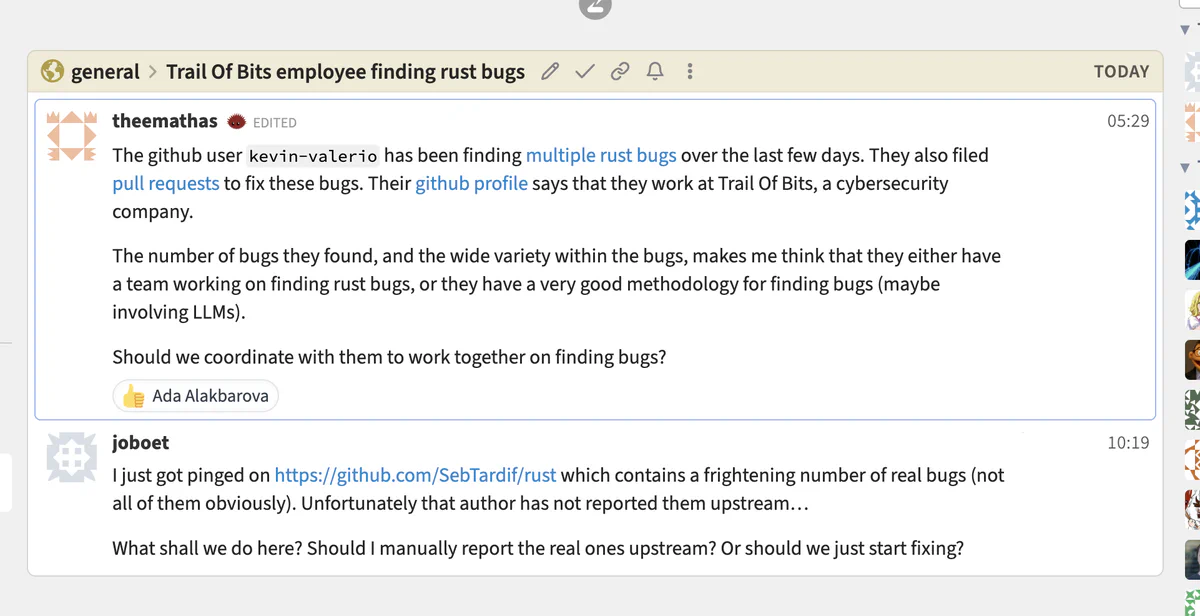
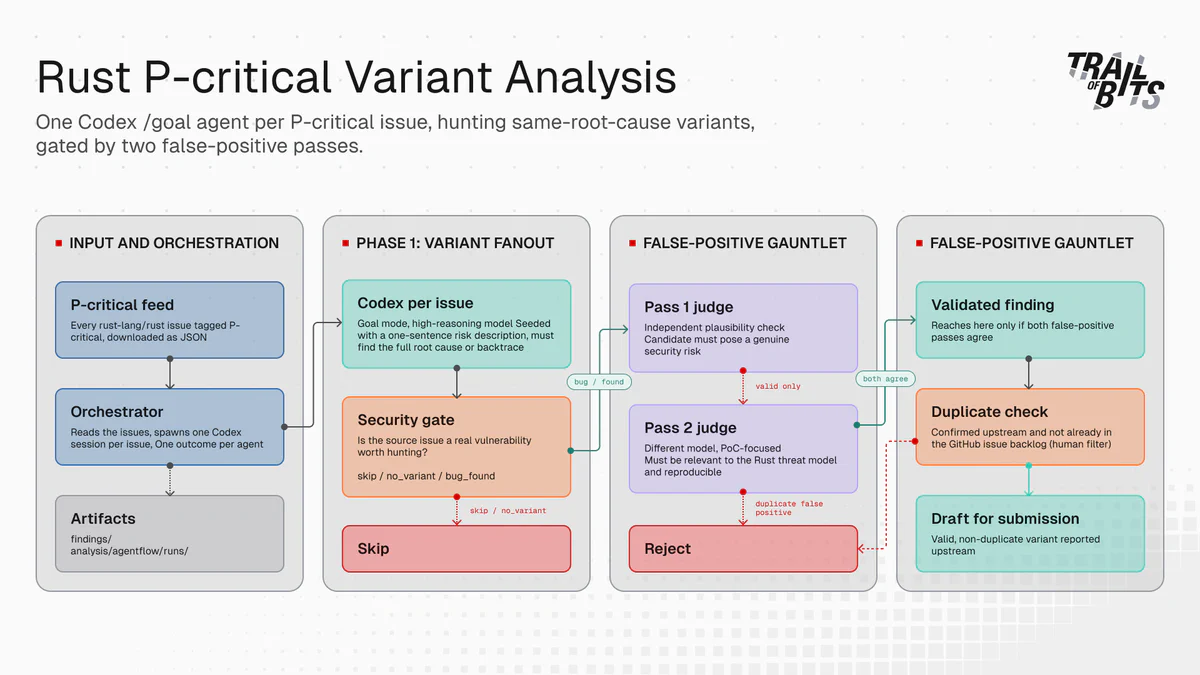
One of our engineers, Kevin Valerio, created an automated variant-analysis system for the Rust compiler leveraging /goal. Every Rust bug we submitted through Patch the Planet came out of it.
-
P-critical is a label created by Rust maintainers to identify bugs that should be prioritized to patch and merge. The pipeline began by downloading every issue tagged P-critical in the rust-lang/rust repository as JSON.
-
An orchestrator reads the issues and spawns a separate agent for each one. One outcome per agent: instead of a single session told to perform variant-analysis on each bug, the orchestrator creates one Codex session per issue, each running an independent task to find a single outcome.
-
Each session runs in Goal mode with a deliberately small prompt to find a security issue with the same root cause as the original bug in P-critical. It receives a one-sentence description of the risk rather than an exact root cause with a full backtrace, so the model can still have the freedom to explore the codebase more.
-
Before any variant hunt begins, a security gate asks whether the source issue is even a real vulnerability and routes it to skip, no_variant, or bug_found. We are using that to focus on the most impactful P-critical bugs.
-
Every candidate runs a two-pass false-positive gauntlet. The first judge checks that the bug poses a genuine security risk. The second, a different model entirely, runs a PoC-focused pass and demands that the issue can potentially cause security issues relevant to the Rust threat model. A candidate reaches “validated finding” only if both passes agree.
-
Validated findings pass one last human filter. A duplicate check happens before anything is opened. Only bugs that are confirmed upstream and not already found in GitHub’s issue backlog are drafted for submission.
Where human judgment is needed
Since its release, /goal has been a powerful tool for amplifying the bug-hunting work that we do. Codex can create custom security infrastructure that takes a security researcher weeks to build in under a day. It can scour thousands of lines of code faster than any human can.
/goal will faithfully pursue whatever outcome we give the model, which means the run is mostly decided before the model starts. But its effectiveness still depends on an expert knowing where to look, verifying its results count as a reportable finding, and knowing what the maintainers on the other side actually want to see as a valid vulnerability disclosure. Prompt engineering is a large part of it, but you can only write a good prompt if you know exactly what you’re looking for.