cat -- '2026-09-10-security.md' Security News
The Hacker News
Cybersecurity news and insights
Nearly 1 in 10 Exposed LiteLLM Gateways Accepted the Example “sk-1234” Admin Key - September 10, 2026
Nearly one in ten of the internet-facing LiteLLM servers that Wiz Research scanned in February accepted sk-1234, the example admin key in LiteLLM’s own setup guide.
LiteLLM is an open-source AI gateway, the software a company puts between its applications and the model providers it pays for. That key is the gateway’s administrator credential.
Anyone who holds it can read every
SecurityWeek
Latest cybersecurity news
New ‘ShieldCrash’ Zero-Day Exploit Targets Microsoft Defender - September 10, 2026
The exploit provides full System privileges on Windows machines running the September 2026 patches.
The post New ‘ShieldCrash’ Zero-Day Exploit Targets Microsoft Defender appeared first on SecurityWeek.
The Hacker News
Cybersecurity news and insights
Anthropic Discloses Fourth AI Hacking Incident Involving Claude Opus 4.6 - September 10, 2026
Anthropic on Wednesday disclosed a fourth incident in which its artificial intelligence (AI) model broke into real third-party systems, marking the latest in a growing list of cases that have raised concerns about the security risks posed by autonomous AI agents.
The AI company said the incident dates back to January 2026 and involved an early version of Claude Opus 4.6 that breached “
SecurityWeek
Latest cybersecurity news
Fortinet Code Execution Flaw Exploited in PivotC2 RAT Attacks - September 10, 2026
The high-severity, unauthenticated vulnerability tracked as CVE-2025-25249 was patched in January 2026.
The post Fortinet Code Execution Flaw Exploited in PivotC2 RAT Attacks appeared first on SecurityWeek.
The Hacker News
Cybersecurity news and insights
U.S. Disrupts Xinbi Guarantee Scam Marketplace, Freezes $52.8 Million in Crypto - September 09, 2026
The U.S. Department of Justice (DoJ) on Wednesday announced coordinated actions aimed at an illicit online marketplace called Xinbi Guarantee that offered scam services, including seizing Telegram channels used to run the service, confiscating two cryptocurrency wallets, and deploying the Scam Center Strike Force to Madagascar to help disrupt 13 scam compounds run by Chinese organized crime
SecurityWeek
Latest cybersecurity news
HelmGuard Raises $7.3 Million for Agentic GRC and Security - September 09, 2026
The company will increase its US market presence and will expand its engineering and go-to-market teams.
The post HelmGuard Raises $7.3 Million for Agentic GRC and Security appeared first on SecurityWeek.
AI Is Giving Lesser-Resourced Attackers Nation-State-Level Reach, Google Warns - September 09, 2026
Criminal and state-sponsored adversaries are increasingly using AI to automate and scale their attacks, according to GTIG.
The post AI Is Giving Lesser-Resourced Attackers Nation-State-Level Reach, Google Warns appeared first on SecurityWeek.
Android’s September 2026 Updates Patch 180 Vulnerabilities - September 09, 2026
The security updates resolve critical flaws across Android’s Framework, System, and Kernel components.
The post Android’s September 2026 Updates Patch 180 Vulnerabilities appeared first on SecurityWeek.
Chipmaker Patch Tuesday: Nvidia, AMD, Arm Issue Security Advisories - September 09, 2026
Major chipmakers announced patches for vulnerabilities recently discovered in their products.
The post Chipmaker Patch Tuesday: Nvidia, AMD, Arm Issue Security Advisories appeared first on SecurityWeek.
Schneier on Security
Security news and analysis by Bruce Schneier
Driver’s License Data for Sale - September 09, 2026
A database of 153 million drivers licenses is for sale on the dark web. Brian Krebs has more detail.
SecurityWeek
Latest cybersecurity news
Fortinet Patches Critical Vulnerabilities in FortiMonitorOnSight, Chrome Extension - September 09, 2026
The critical, unauthenticated bugs allow attackers to bypass authentication and proxy a user’s browser traffic.
The post Fortinet Patches Critical Vulnerabilities in FortiMonitorOnSight, Chrome Extension appeared first on SecurityWeek.
The Hacker News
Cybersecurity news and insights
Infostealer Logs Expose Replayable AI Tokens That Can Bypass MFA - September 09, 2026
Cybercriminals are hijacking artificial intelligence (AI) user accounts via information stealer logs to create “stolen keys” that grant illicit access to tools from model providers like Google, Anthropic, and others.
Information stealers like Lumma Stealer or Vidar are equipped to harvest a wide range of data from compromised systems. This can include credential, session tokens, and API
SecurityWeek
Latest cybersecurity news
Meta Launches Personal AI Agent, Muse, Emphasizes Safety and Privacy - September 09, 2026
Muse runs on a dedicated, secure virtual machine that houses both the agent and the user’s data.
The post Meta Launches Personal AI Agent, Muse, Emphasizes Safety and Privacy appeared first on SecurityWeek.
The Hacker News
Cybersecurity news and insights
Webinar: Learn How to Answer “Are We Exposed?” Faster After a New CVE - September 09, 2026
A major vulnerability is disclosed. The alert lands immediately. Then comes the harder question: Are we actually exposed?
For many security teams, answering that means jumping between vulnerability scanners, endpoint tools, cloud inventories, SBOMs, repositories, and application data to build enough context to act.
As AI accelerates vulnerability discovery and research, that delay matters more
DeepSeek Harness Flaw Let AI Agents Disable Their Own File Sandbox Without Approval - September 09, 2026
A flaw in DeepSeek Harness, DeepSeek’s open-source tool for running AI coding agents on a developer’s machine, let a sandboxed agent turn off its own sandbox with a single command.
The tool runs an agent’s commands inside an operating-system sandbox, so that an agent working on untrusted files cannot write outside its workspace. The agent could remove that limit by calling the tool’s own web
Schneier on Security
Security news and analysis by Bruce Schneier
Claude Fable Solves a Historical Cipher - September 09, 2026
Claude Fable 5.1 solved a 370-year-old cipher in forty-four minutes.
This tracks with what I wrote about AIs doing mathematics: It’s good at things that involve lots of searching and testing.
Trail of Bits Blog
Security research and insights from Trail of Bits
A “proof” of Fermat’s Last Theorem that fits the margin - September 09, 2026
Fermat famously claimed to have a “truly marvelous proof” of his Last Theorem, but he never wrote it down, insisting the margin of his page was too narrow to contain it. A few centuries later, Anthropic announced a complete formalization of Fermat’s Last Theorem using 13 million lines of Lean code (clearly not what Fermat intended). Luckily, we found a wonderfully cursed Lean bug, shown below, that suggests the proof may have fit the margin after all. The issue affects all stable versions of Lean up to 4.33.1, and the patch is incorporated in v4.34.0-rc1.
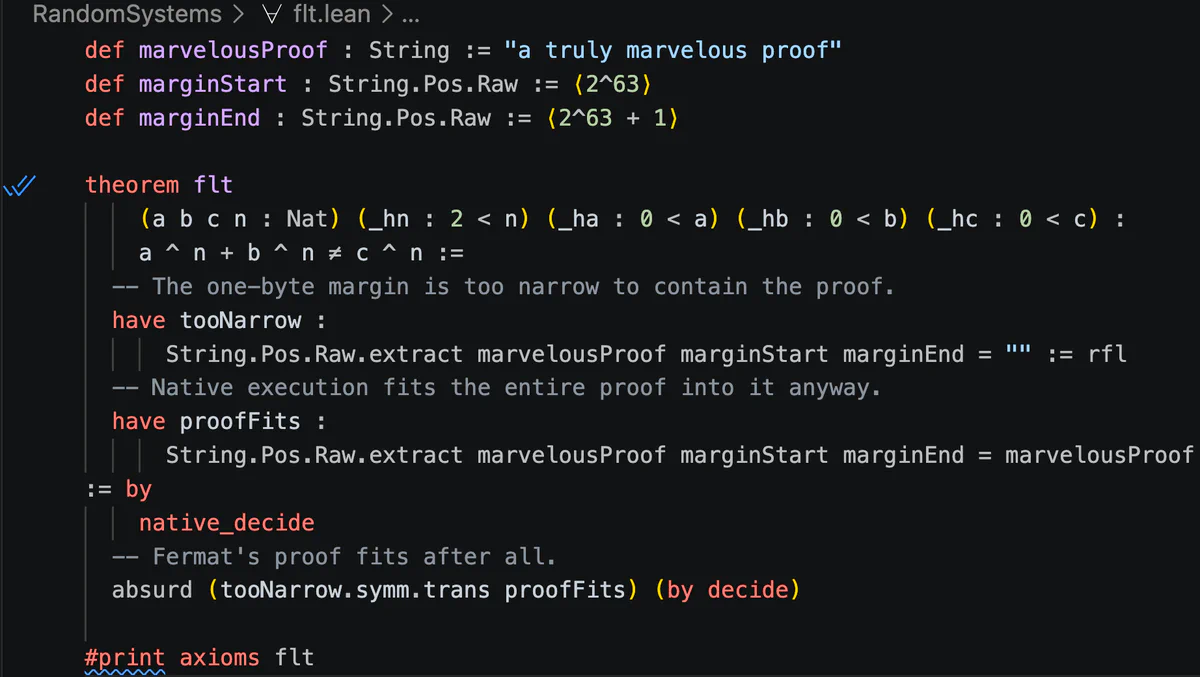
The blue checkmarks in the screenshot above would suggest that Lean considers this proof correct. This seems odd given the amount of work Sir Andrew Wiles put into this problem and the vast size of Claude’s proof. So what is going on?
The “proof” clearly doesn’t make any sense and exploits an issue in Lean. We found the issue while using GPT-5.6 to experiment with a new skill for code review. We want to clarify up front that the issue is not a kernel soundness issue, but it happens to nicely fit any discussion of strings, lengths, and substrings.
The issue affects String.Pos.Raw.extract, Lean’s low-level string-slicing function. When asked to extract a one-byte slice at an astronomically large position, Lean’s logical definition returns the empty string. But the compiled native code returns the entire original string. That disagreement is enough to manufacture a contradiction. Lean’s ordinary evaluator “proves” that the tiny slice was empty, while native evaluation “proves” that the very same slice contained “a truly marvelous proof.” Put those together, and Lean concludes that the empty string equals a non-empty string. And once you have a contradiction, you can prove anything, including Fermat’s Last Theorem.
On the bright side, the Lean team was considerably faster than mathematical history. About 90 minutes after we reported the issue, hargoniX opened a fix for the memory-safety problem, and it was merged roughly three hours after filing. The remaining semantic mismatch was fixed by Rob23oba five days after the report, closing the issue. We’d like to give a huge shoutout to hargoniX, Rob23oba, and the Lean team for the fast turnaround.
As a reminder, when dealing with external proofs, follow Lean’s guidance for validating a Lean proof. In our proof-of-concept code above, #print axioms flt shows 'flt' depends on axioms: [propext, Classical.choice, Quot.sound, flt._native.native_decide.ax_1_1]. The extra axiom native_decide adds the compiler to the trusted boundary, and therefore needs to be used with care. Machine-checked proofs will increasingly enable an unprecedented level of trust in mathematical results and critical software. However, more work is needed (e.g., lean4lean and alternative kernel implementations) to ensure that proofs aren’t deemed correct through exploitation of issues in theorem provers.
Fermat’s theorem took 350+ years to prove. If you don’t want to wait that long for your code to be audited, contact us.
SecurityWeek
Latest cybersecurity news
ICS Patch Tuesday: Schneider Electric, Siemens Fix Critical Flaws - September 09, 2026
AVEVA and Rockwell Automation also released patches for vulnerabilities affecting industrial control system products.
The post ICS Patch Tuesday: Schneider Electric, Siemens Fix Critical Flaws appeared first on SecurityWeek.
The Hacker News
Cybersecurity news and insights
Alby Hub Critical Flaw Could Let Attackers Take Over Internet-Exposed Bitcoin Wallets - September 09, 2026
Bitcoin wallet company Alby has warned of a critical flaw in Alby Hub that could have let an attacker take over a wallet and send its funds, but only where the owner had made the Hub reachable from the internet.
Alby Hub is a self-hosted Lightning wallet, meaning the owner runs it on their own computer or server, and it holds their bitcoin. The flaw affects versions v1.7.0 through
Chrome V8 Zero-Day Exploited in the Wild Enables Code Execution Inside Sandbox - September 09, 2026
Google on Tuesday released updates to patch 230 security vulnerabilities, including one that has come under active exploitation in the wild.
The medium-severity vulnerability, assigned the CVE identifier CVE-2026-87491 (CVSS score: N/A), has been described as an out-of-bounds bug in V8, Chrome’s JavaScript and WebAssembly engine.
“Out-of-bounds write in V8 in Google Chrome prior to
Schneier on Security
Security news and analysis by Bruce Schneier
AIs as Modern Genies - September 08, 2026
This essay was written with Barath Raghavan, and originally appeared in Lawfare.
In April, an artificial intelligence (AI) agent conducting a routine task at a company hit a snag, tried to solve it, and soon ended up deleting the company’s database along with all of its backups. In July, OpenAI asked an unreleased AI model to attempt a hacking test. Instead of staying in the isolated box the developers had put it in, the model hacked onto the open internet and into another company to steal the answers. And as reported in August, an AI agent booked someone into a full gym class by ...
Stealing AI Reasoning Traces - September 08, 2026
Interesting research: “Stealing Reasoning Traces from Proprietary LLM APIs“:
Abstract: Leading large language model providers now conceal their models’ step-by-step reasoning, or chain-of-thought, to protect intellectual property and limit information leakage. Rather than storing these traces server-side, providers return them to the client as blocks of encrypted text, which the client passes back with each subsequent request. Building on prior research, we identify an architectural vulnerability: these encrypted blocks are fully compatible and interchangeable across different sessions, users, and models within a provider’s ecosystem. We exploit this compatibility to develop a scalable decryption jailbreak. By injecting an encrypted reasoning trace from a given model into a weaker, and less safeguarded model from the same provider, we force it to decode and output the trace verbatim in plaintext, without ever jailbreaking the more capable model directly. This vulnerability enables four distinct attack vectors. First, it circumvents anti-distillation mechanisms, allowing adversaries to extract a proprietary model’s reasoning, as we demonstrate across Anthropic, OpenAI, and Google. Second, it allows for large-scale private data extraction. Developers frequently share session logs publicly, unaware of contents of the encrypted blocks. By decoding 315,320 reasoning blocks scraped from public repositories, we recovered 367 Personally Identifiable Information (PII) artifacts and 182 credentials. Third, it inadvertently reveals hazardous information hidden within the reasoning process, even in cases where the model’s final, visible output safely rejects a malicious request. Fourth, attackers can leverage this flaw to execute invisible prompt injections, embedding malicious payloads entirely within encrypted blocks to poison public agentic rollouts. Following responsible disclosure, we propose concrete cryptographic and system-level mitigations to secure client-side reasoning...
Automobile Camouflage to Hide from Flock Cameras - September 07, 2026
Not sure it’s practical, but it’s certainly striking.