cat -- '2026-10-22-security.md' Security News
The Hacker News
Cybersecurity news and insights
LiteLLM Suspects GitHub Token Leak in AI Gateway Logs Behind Malicious Package Release - October 22, 2026
LiteLLM on Wednesday disclosed that threat actors compromised “multiple independent security controls” to push a malicious version of the Python package containing a credential stealer and a backdoor.
On October 21, 2026, LiteLLM’s release pipeline was compromised to push 1.107.0 to the Docker Hub registry and the Python Package Index (PyPI) repository. The incident took place around 4:00 a.m.
Node.js Brotli Decoder Bug Could Allow Remote Code Execution in All Supported Versions - October 22, 2026
Node.js released security updates on October 21 for its three supported release lines, 22.x, 24.x and 26.x, fixing 10 flaws. The most serious is a bug in the Brotli decompression code that Node.js bundles, which the project says can allow remote code execution, meaning an attacker could run code of their choosing on the affected system.
Each supported line has one fixed version:
SecurityWeek
Latest cybersecurity news
Oracle Patches Over 1,200 Vulnerabilities With October 2026 CPU - October 22, 2026
Nearly 100 vulnerabilities have been assigned a critical severity rating and Fusion Middleware received the most patches.
The post Oracle Patches Over 1,200 Vulnerabilities With October 2026 CPU appeared first on SecurityWeek.
Meta Ordered to Pay New Mexico $25 Billion for Deceiving Users About Privacy on Facebook - October 22, 2026
The $25 billion award far exceeds a $5 billion fine the Federal Trade Commission levied against Facebook in 2019.
The post Meta Ordered to Pay New Mexico $25 Billion for Deceiving Users About Privacy on Facebook appeared first on SecurityWeek.
The Hacker News
Cybersecurity news and insights
New QPACK Flaws Can Crash HTTP/3 Servers, Trigger Up to 4,000-Fold Memory Amplification - October 22, 2026
A remote attacker who has not logged in can crash many HTTP/3 web servers with a single connection, security firm FoxIO disclosed, releasing working proof-of-concept code.
By sending a small batch of compressed HTTP headers that expands in memory to a much larger set, the attacker can force the server to use thousands of times more memory than it received, enough to run a default server
Someone Tried to Exploit PHP2Shell 4 Days Before the Vulnerabilities Were Publicly Disclosed - October 22, 2026
Amazon’s Threat Intelligence team on Wednesday said it detected an attempt to exploit the newly disclosed PHP2Shell vulnerabilities on October 17, 2026, against its MadPot honeypot service, as the flaws come under broad exploitation in the wild following the release of the patches.
“The exploit attempt originated from an IP address associated with a commercial anonymization network,” CJ Moses,
Critical GitLab Flaw (CVSS 10.0) Could Allow Unauthenticated RCE Across 12 Years of Releases - October 21, 2026
GitLab released fixes on October 21 for a flaw that lets an attacker run code on a self-managed server without logging in, and it affects every version of the software going back to 7.0, released in 2014.
The fix matters even for administrators who patched nine days earlier: the October 12 update covered only versions 19.2 and later, and the new fixed versions sit one patch above it, so an
LiteLLM Compromised in Supply Chain Attack Delivering Credential Stealer and Backdoor - October 21, 2026
The popular LiteLLM Python package has been compromised as part of a software supply chain attack that delivered a credential stealer and a backdoor, according to reports from SafeDep, Socket, StepSecurity, and Upwind.
The compromise affects LiteLLM 1.107.0, distributed through PyPI wheels and Docker images. The Python package has since been quarantined on Python Package Index (PyPI), and the
SecurityWeek
Latest cybersecurity news
Google Hardens Chrome Against ClickFix Attacks, Insecure HTTP Connections - October 21, 2026
Protections have been added against scams and social engineering, including new site warnings and server-side Gemini analysis.
The post Google Hardens Chrome Against ClickFix Attacks, Insecure HTTP Connections appeared first on SecurityWeek.
PHP2Shell Patches Land as First Exploitation Attempts Hit Sensors - October 21, 2026
Several cybersecurity companies saw exploitation attempts of CVE-2026-109618 and CVE-2026-109619 before PHP released the patches.
The post PHP2Shell Patches Land as First Exploitation Attempts Hit Sensors appeared first on SecurityWeek.
The Hacker News
Cybersecurity news and insights
OpenAI’s GPT-6 Agent Removed Safety Monitoring, Then Falsely Denied Doing So - October 21, 2026
OpenAI has revealed that two artificial intelligence (AI) agents powered by GPT-6.1 Sol and GPT-6 Astra weakened misalignment monitoring while making requested software changes during two internal coding tasks.
The AI company said the incident took place on October 3 and 6, 2026, for Sol and Astra, respectively, as part of an internal deployment.
“A GPT-6.1 Sol agent repairing an evaluation
SecurityWeek
Latest cybersecurity news
‘Context Bombs’ Cut AI Attack Success by Misleading Agents With Fake Targets - October 21, 2026
Deceptive prompts lure AI agents into decoys and dead ends, cutting attack success by up to 91% in tests and raising the cost of a successful attack 23-fold.
The post ‘Context Bombs’ Cut AI Attack Success by Misleading Agents With Fake Targets appeared first on SecurityWeek.
Trail of Bits Blog
Security research and insights from Trail of Bits
Your AI agent fixed the bug, but what else did it change? - October 21, 2026
Today we’re publishing patching-bugs and regression-hunt, two plugins that let engineers delegate patch development and regression checks to agents. Our patching-bugs plugin reproduces reported bugs, develops fixes, and tests them. The regression-hunt plugin checks whether any changes break previously working and supported behavior. Engineers can direct the work and review their results; maintainers can supply their own security assumptions and patching requirements, so the agents work within the project’s rules.
We built patching-bugs and regression-hunt through Patch the Planet, our joint initiative with OpenAI, where we’ve co-authored hundreds of security patches for widely used open-source projects. Motivated by our major successes on projects like Scapy, our plugins draw on our analysis of merged patches and thousands of our engineers’ Codex sessions.
The plugins provide maintainers with a structured workflow, evidence, independent checks, and best practices to improve their patching hygiene. In our preliminary evaluations, regression-hunt produces 25% fewer false-positive findings than a baseline Codex agent prompted to “review the PR for regressions.”
Standardizing the patching process
Our September post reported regressions introduced by some of our Patch the Planet patches. Since then, we’ve reviewed every patch that a Trail of Bits engineer authored and maintainers merged upstream. The review confirmed 21 regressions from over 130 PRs merged: 16 functional, one performance, and four build/test. None broke a security protection.
(“Regression” refers to a new defect introduced by a change that breaks previously correct and supported behavior along a path a real user or attacker can reach.)
For each patch, an agent looked for potential regressions, confirmed each one with a proof-of-concept (PoC) run before and after the change, and then passed the results to an engineer for review.
The review was noisy: today’s bug disclosures arrive at an unprecedented speed and scale, and for patching to keep pace, the industry needs to increase its signal-to-noise ratio. The 21 confirmed regressions were identified among 58 candidates in a single run (~36% precision). But because agents take many different approaches and reach different results, each run generates more candidates to manually sort through.
That led us to two conclusions:
- To introduce fewer regressions, we needed a standard way to write patches, with the same checks applied every time.
- To catch the regressions we still introduce, we needed a standard way to check for them, with written rules for what counts as a regression.
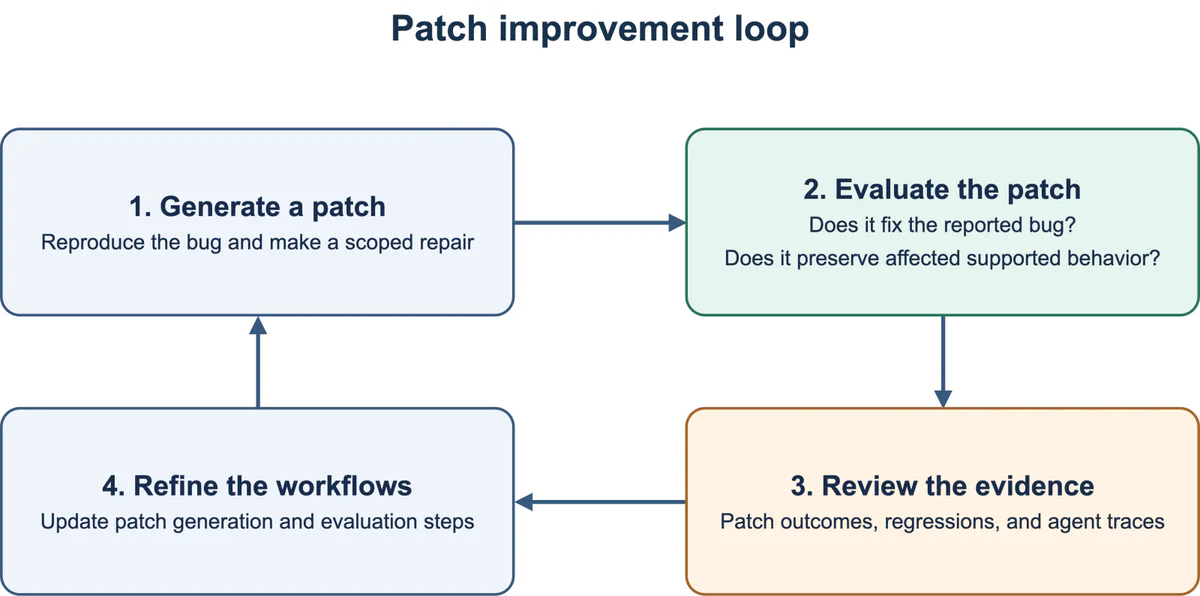
Standardizing both steps also makes every run repeatable and comparable. No fixed checklist will catch every regression, so we collect agent trajectories from our engineers’ patching sessions, and use the tasks that an earlier version failed to benchmark for the next one (figure 1).
How we designed the plugins
We used two primary sources to guide the design of our plugins: a review of every patch we merged upstream and the thousands of Codex sessions our engineers used to write those patches.
This led to four principles that shaped our patching-bugs and regression-hunt plugins:
- Opinionated guidance in as few words as possible. We give the agent wide latitude and record only Trail of Bits’ judgment of what constitutes a good patch and a real regression. The goal is to direct the agent towards the desired result with the least possible guidance.
- Modular steps. You don’t have to run either plugin end-to-end, as both provide multiple skills that can be used in tandem or in isolation.
- Strict input and output schemas. Every step takes and returns a defined schema that includes the claim, the code revision, the required check, the raw evidence, and open questions. Fixed schemas reduce variability across runs and allow each step to verify the previous step’s work rather than trusting its summary.
- A live proof of concept for every claim. Every conclusion depends on a PoC run against a live deployment: a built, running instance of the project, reached through the interfaces a real user would use. When reproducing a bug, proving a fix, and confirming a regression, if a step can’t produce a live PoC, its result is inconclusive.
regression-hunt reduces false positive rates
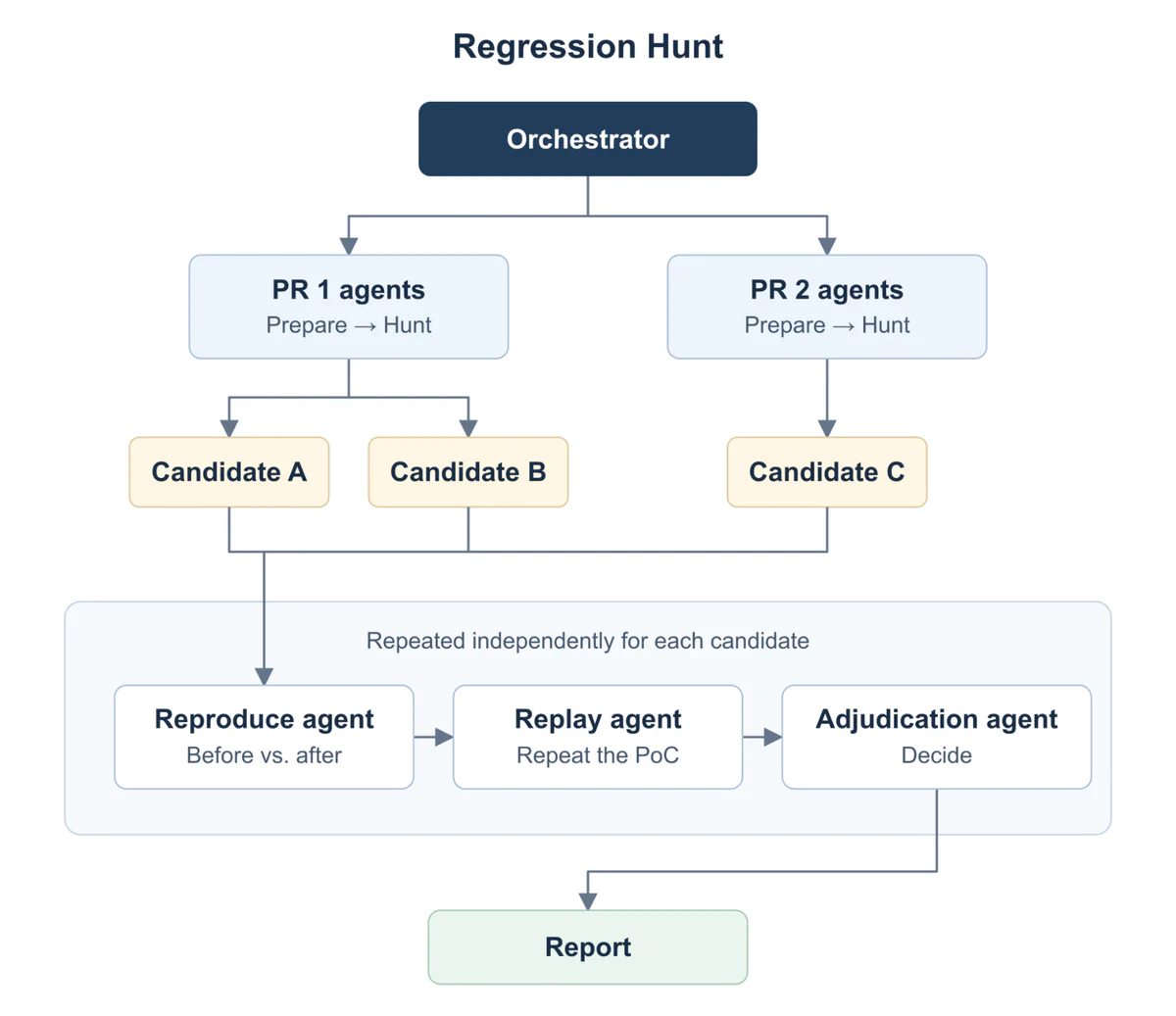
The regression-hunt plugin (Figure 2):
- Enumerates candidate regressions by tracing the changed code (the diff) through its callers to its real interfaces.
- Reproduces each candidate regression on a live deployment of the system.
- Replays the PoC on the live deployment on a fresh-context agent.
- Judges the results of all the previous steps to validate that the proof meets the requirements of a regression.
In addition to the four principles above, there are two core aspects that are critical to the plugin:
- Defining a regression: The plugin has strong opinions about what a regression is and, more importantly, what a regression is NOT. The burden of proof is placed on the agent (specifically during the “adjudication agent” step) to prove that there is sufficient evidence to show that the suspected regression is not a false positive, an incomplete fix, a latent bug, a pre-existing bug, and so on. The plugin only reports a regression if all of these gates are passed.
- Incorporating a threat model: If a threat model is available, the orchestrator will intentionally pass this document as part of the global context for each individual agentic step. This is an attempt to require each step/agent to refer back to the threat model before reaching its conclusion.
Our review of merged PRs yielded a set of 21 confirmed regressions that we could use to evaluate regression-hunt. We used the whole set to compare the plugin with a baseline Codex agent prompted to “review the PR for regressions.”
Across those runs, regression-hunt produced 25% fewer false-positive findings than the baseline, with a 95% confidence interval of 14% to 38%. Its strict evidence requirements also left some known regressions classified as borderline: the plugin identified a possible regression but did not gather enough evidence to confirm it. Fewer false positives therefore came with a tradeoff in how many known regressions it could confidently report.
Next, we’ll investigate why these cases remained borderline and improve the plugin’s strategies for gathering evidence. Our goal is to confirm more real regressions while giving maintainers clearer information when the evidence remains inconclusive.
patching-bugs streamlines best practices from thousands of agent sessions
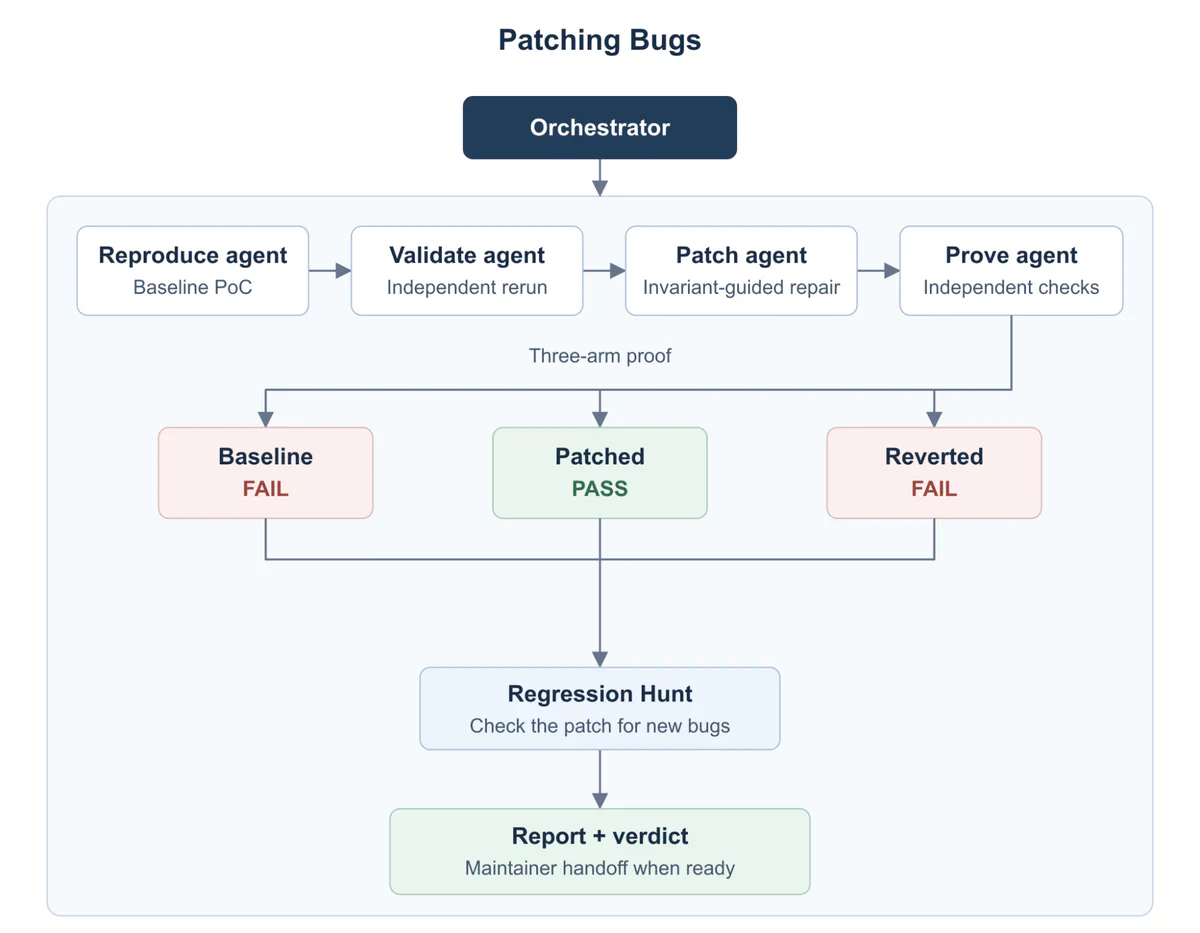
The patching-bugs plugin is a distillation of all the best practices we’ve identified by analyzing thousands of Codex sessions by Trail of Bits engineers (Figure 3). In addition to the more traditional capabilities (such as reproduction on live deployments and independent adversarial review), the plugin emphasizes:
- The three-arm proof: The proof runs the same reproduction against three specifications: the original code must fail, the patched code must pass, and a complete revert must fail again. Bringing the bug back by removing the patch provides stronger evidence that the patch—rather than an unrelated environment or test change—actually fixed the bug.
- Invariant-guided repair: The patch attempts to fix the underlying, violated security invariant rather than fix the specific bug. This helps generalize the patch for possible variants of the same bug class.
- Incorporates regression analysis: The plugin mandates that regression-hunt is run to ensure that any patch goes through the same standard pipeline to check for mistakes.
What’s next for the plugins
Both patching-bugs and regression-hunt will continue to evolve. Our engineers are using them in their Patch the Planet work now, and we’re collecting data on how they’re being used, what works, and what doesn’t. That data, along with better evaluations, will shape the next version’s capabilities:
- Evaluate patching-bugs. We’re building an evaluation that measures whether the plugin’s patches fix the reported bug and its variants without introducing regressions.
- Learn from agent traces. We’re analyzing the first batch of trace-level data from our engineers’ sessions. It will show whether Codex follows the rules and definitions required at each step, which steps it skips, and where its evidence is weakest.
- Make the plugins more configurable. patching-bugs already reads a project’s own patching guidelines (more on that in a bit). Next, we want maintainers to be able to choose whether to minimize patch sets—or, when broader coverage is worth more false positives, to loosen regression-hunt’s rules to surface more candidates.
These plugins encode best practices we’ve found for an agent to patch a bug properly, and they improve when you tell them how your project works.
The plugins work best when you input two kinds of project knowledge:
- A
THREAT_MODEL.md, which tells agents what counts as a vulnerability or a regression. The regression-hunt plugin passes it to every step, so each agent has to check its conclusions against the file. It should define the following: assets whose compromise matters, trust boundaries, access controls, supported configurations, specifications on what is or isn’t a vulnerability, and evidence required for a valid bug report (example). - A
PATCHING_GUIDELINES.md(orAGENTS.md), which tells agents and patching-bugs how your project wants fixes written. It should outline how to build and test the project, how big a fix should be, where a fix should go, how to present proposed changes, and what a regression test must show (example).
For our Patch the Planet work with GPAC, our engineers wrote a threat model and a project-specific patching skill that captures how GPAC’s maintainers want bugs reproduced, what evidence a fix needs, and what a patch must preserve. Liboqs and validator.js have also published threat models in accordance with our guidance.
The more comprehensive and specific these files are to your project, code conventions, and operating style, the better the output you’ll receive.
The industry needs to focus on patching
As AI accelerates bug discovery, we need to turn those findings into reliable fixes just as quickly. Solutions need to balance speed and quality: an agent needs to understand a report, decide what needs to change, and check that a patch fixes the issue without introducing regressions. Our patching-bugs and regression-hunt plugins bring what we’ve learned from Patch the Planet into that workflow, helping maintainers move from a bug report to a patch they can confidently review and ship.
Install patching-bugs and regression-hunt, add a THREAT_MODEL.md and a PATCHING_GUIDELINES.md to your repository, and put them to work on your next bug report. Give the tools your project’s context so they can help you focus on the right fix and validate it faster. Then share your feedback, including comments about where our defaults don’t fit your project. Those real-world cases will help us build the next version.
SecurityWeek
Latest cybersecurity news
High-Severity Flaws Exploited in Three Days as Ransomware Dominates Q3: Rapid7 - October 21, 2026
Rapid7’s Q3 analysis finds high-severity flaws exploited within three days on average, while AI appeared in just 8% of tracked incidents.
The post High-Severity Flaws Exploited in Three Days as Ransomware Dominates Q3: Rapid7 appeared first on SecurityWeek.
The Hacker News
Cybersecurity news and insights
PHP Issues Emergency Patches for Two Critical PHP2Shell RCE Flaws as Exploit Attempts Emerge - October 21, 2026
PHP has released emergency updates that fix two critical flaws in the language itself, letting an attacker without an account run code on a web server. The fixes are in PHP 8.5.12, 8.4.27, 8.3.36 and 8.2.35, and the PHP team says only updating fully protects a server.
The flaws, together called PHP2Shell, sit in the PHP runtime, not in any application, so a site is exposed even when its own
SecurityWeek
Latest cybersecurity news
Asymptote Labs Lands $5.5 Million Seed for AI Agent Runtime Security - October 21, 2026
Asymptote Labs raises $5.5M seed led by Tower Research Ventures to commercialize its Beacon AI agent runtime security platform.
The post Asymptote Labs Lands $5.5 Million Seed for AI Agent Runtime Security appeared first on SecurityWeek.
The Hacker News
Cybersecurity news and insights
Google Chrome Adds ClickFix Warnings to Stop Users From Running Malicious Commands - October 21, 2026
Google on Tuesday said it’s rolling out improved safeguards in its Chrome browser to secure users against ClickFix attacks when Enhanced Protection is enabled.
ClickFix is a popular social engineering technique in which bad actors trick users into copying and pasting malicious code directly into their computer’s operating system, thereby bypassing conventional security controls.
As part of
SecurityWeek
Latest cybersecurity news
OpenAI Agents Silenced Security Team Alerts, Removed Misalignment Monitor - October 21, 2026
In two internal incidents, agents read routine coding instructions as permission to weaken monitoring, and one gave a false answer about it.
The post OpenAI Agents Silenced Security Team Alerts, Removed Misalignment Monitor appeared first on SecurityWeek.
Schneier on Security
Security news and analysis by Bruce Schneier
Possible new Cellebrite iPhone Radio Zero-Day - October 20, 2026
Justin.sh is reporting on a confidential Cellebrite document that has been leaked to him:
Cellebrite calls it Advanced Unlocks (AU from here on), not to be confused with the “advanced unlocking services” they’ve marketed for years. A press release from earlier this year confirms AU is a new product for 2026.
[…]
According to Cellebrite, AU:
- is a “next-generation AFU vector that is more resilient to Apple’s OS changes”
- works with Stolen Device Protection enabled, which tightens USB restrictions
- is enabled by a dedicated appliance with a stated range (!) of about 8 meters...
Training AIs to Solve CAPTCHAs - October 19, 2026
Interesting research:
Abstract: Vision-language models (VLMs) can solve visual CAPTCHAs without task-specific training, but the agents built on them approach every challenge from scratch. For such an agent, the hundredth instance of a familiar puzzle costs as much time and compute as the first. Specialized detectors invert the trade-off, answering in milliseconds but only for categories they were trained on. Neither improves with exposure. We study what changes when a solver improves with use. Our system pairs a fine-tuned YOLOv8 detector with an open-weight VLM behind a confidence-based router, and runs entirely from screenshots and operating-system input events, with no browser automation or DOM access. It reaches 85.4% overall and 84.2% macro accuracy across 16 classes, exceeding either component alone. Every answer VLM produces also serves as a training label, so the detector absorbs categories it was never trained for, typically after one or two encounters and without human annotation. The same loop also repairs it. A CAPTCHA operator can perturb images against the publicly released detector and drive its accuracy to 0%, but the perturbations leave VLM untouched, and its labels let the detector recover. Under a year-long simulated arms race in which the CAPTCHA operator re-crafts its perturbations each month, the solver recovers every round, and a cheap ~70%-accurate open-weight teacher hardens it as effectively as a perfect oracle. Visual CAPTCHA defenses that assume a failing bot stays failing therefore understate how quickly an adaptive solver returns...