cat -- '2026-11-04-security.md' Security News
The Hacker News
Cybersecurity news and insights
Critical Rails Flaw Lets Attackers Write Server Files via Crafted ImageMagick Uploads - November 04, 2026
A critical flaw in Ruby on Rails could allow an unauthenticated attacker to write arbitrary files on an app’s server by uploading a crafted file if the app processes uploads using ImageMagick. The Rails project disclosed the flaw in an advisory and fixed it in versions 8.1.4.1 and 8.0.5.2.
The flaw is in Active Storage, the part of Rails that handles file uploads. Some apps store
Xen Hypervisor Flaws Let One Malicious VM Read and Write Any Other VM’s Memory - November 04, 2026
Two flaws in the Xen hypervisor allow a malicious guest virtual machine (VM) to read and write the memory of other VMs on the same host, including dom0.
Dom0 is the VM that, by default, has full permissions and manages the others. Patches are out, and there is no known mitigation, the Xen Project said in an advisory on November 3.
All Xen versions from 4.6 onward are vulnerable,
Radio With No Radar: Why Agent Runtime Security Fails Without the Layers Beneath It - November 04, 2026
Nearly every agent security pitch now ends on the same promise: the product stops the bad action in real time. The promise holds for one kind of agent, the kind whose traffic passes through a gateway the enterprise owns. Most agents never touch one.
One recent case shows what that gap looks like in practice. An employee asked an AI assistant to trigger a mass-email automation. The automation
SecurityWeek
Latest cybersecurity news
Malicious cPGuard Updates Served in OpsShield Supply Chain Attack - November 04, 2026
Using compromised credentials, the attackers accessed OpsShield’s update servers and poisoned multiple cPGuard versions.
The post Malicious cPGuard Updates Served in OpsShield Supply Chain Attack appeared first on SecurityWeek.
Rigged Coding Assignment, Abused AI Tool Opened Path to $6 Billion Binance Heist - November 04, 2026
Binance’s first incident report traces the record theft to a months-long campaign that compromised three engineers’ computers.
The post Rigged Coding Assignment, Abused AI Tool Opened Path to $6 Billion Binance Heist appeared first on SecurityWeek.
The Hacker News
Cybersecurity news and insights
Google Issues Patches for Critical Android Flaw That Could Allow RCE Without User Interaction - November 04, 2026
A critical Android flaw could allow an attacker to run code on a phone without any user action remotely, Google said in its November security bulletin.
The flaw, CVE-2026-58868, affects Android 14 through 17. Phones get the fix with security patch level 2026-11-01 or later, which phone makers and carriers send on their own schedules.
As of November 4, Google’s bulletin did not report
CISA Confirms Hackers Exploiting WordPress Core Flaw During Software Upgrades - November 04, 2026
The U.S. Cybersecurity and Infrastructure Security Agency (CISA) has added a security flaw in WordPress Core to the Known Exploited Vulnerabilities (KEV) catalog, citing evidence of active exploitation.
The high-severity vulnerability, tracked as CVE-2026-119977 (CVSS score: 8.1), is a case of Time-of-check Time-of-use (TOCTOU) race condition that could be exploited to achieve arbitrary code
mSecure Warns Users to Change Passwords, Reset 2FA and Passkeys After Suspicious Activity - November 03, 2026
Customers of the mSecure password manager are being urged to act now to protect the confidential information they store in it, possibly by changing passwords, resetting two-factor authentication (2FA), and removing passkeys.
The warning came in an email sent on November 3 in the name of developer mSeven Software. It says the company recently learned of suspicious activity linked to the app but
Chainstack Reports Production Systems Breach Exposing Customer Data and Password Hashes - November 03, 2026
Blockchain infrastructure provider Chainstack on Tuesday disclosed that it was targeted in a cyber attack that allowed an unauthorized party to gain access to some parts of its infrastructure.
The incident is assessed to be part of a large-scale, artificial intelligence (AI)-powered attack campaign that came to light last week.
“An external attacker gained unauthorized access to part of
Binance Reveals How Fake Job Interviews and AI Tool Abuse Led to $6.43 Billion Theft - November 03, 2026
Binance on Tuesday said the record-setting theft of $6.43 billion in assets from the world’s largest cryptocurrency exchange was the culmination of a “sophisticated, multi-stage campaign” that involved the use of a tampered Homebrew installation and recruitment-themed social engineering attack targeting two of its engineers.
“It was not a single isolated breach or a simple phishing incident,“
SecurityWeek
Latest cybersecurity news
Frontline Education Data Breach Impacts Over 1.3 Million - November 03, 2026
Hackers exploited a flaw in third-party software and stole the personal information of school district staff and students.
The post Frontline Education Data Breach Impacts Over 1.3 Million appeared first on SecurityWeek.
CrowdStrike Reportedly Paying $495 Million for AI Security Firms Fiddler, Dreadnode - November 03, 2026
The acquisitions will add AI agent observability and automated AI security testing capabilities to the CrowdStrike Falcon platform.
The post CrowdStrike Reportedly Paying $495 Million for AI Security Firms Fiddler, Dreadnode appeared first on SecurityWeek.
Android’s November 2026 Updates Patch Over 200 Vulnerabilities - November 03, 2026
The most severe is a critical flaw in Framework leading to remote code execution without user interaction.
The post Android’s November 2026 Updates Patch Over 200 Vulnerabilities appeared first on SecurityWeek.
Critical Node-RED Flaw Exploited in Attacks - November 03, 2026
Multiple attacks from the same IP address attempted to deploy various payloads, including a Linux bot and webshells.
The post Critical Node-RED Flaw Exploited in Attacks appeared first on SecurityWeek.
Schneier on Security
Security news and analysis by Bruce Schneier
AIs Hacking the Law - November 03, 2026
In both a 2021 essay and my 2022 book, A Hacker’s Mind, I talk about AIs finding vulnerabilities and exploits—hacking—the legal system.
Here’s some demonstrations of this from Germany:
Legal systems encode the foundations of social order in natural language. Similar to computer systems, the written law can contain vulnerabilities that invite exploitation.1 Courts absorb most exploits through interpretation, and such vulnerabilities rarely surface in the first place. With highly capable AI systems enabling the discovery of vulnerabilities at unprecedented scale, we believe the latter could change...
Trail of Bits Blog
Security research and insights from Trail of Bits
The cryptography behind electronic voting (and why paper ballots are still essential) - November 03, 2026
As millions of Americans vote in today’s U.S. midterms, most will use paper ballots, which are protected by strict chain-of-custody protocols and, in some cases, statistical audits. You may wonder why we still use paper for our elections and voting systems when tasks like banking, tax filing, and document signing have moved away from paper-based legacy systems and become fully electronic. The short answer: security.
That may come as a surprise to some. After all, cryptography and other security advancements have enabled secure electronic systems for many applications. In fact, cryptography can be used to provide two essential safeguards in elections: keeping (1) individual votes secret while (2) making the final tally independently verifiable. This is exactly the approach of cryptographic protocols like Helios and ElectionGuard. However, Helios intentionally targets lower-risk and lower-coercion settings rather than high-stakes public elections. ElectionGuard, by contrast, is intended for public elections, but not as a replacement for a paper-based system; it is used as a cryptographic layer integrated with traditional voting infrastructure.
In this blog post, we’ll explain how cryptographic techniques can help protect ballot secrecy and prevent manipulation in electronic voting systems, and explore the limitations of these systems. Although cryptography can strengthen election verifiability and have other strong security properties, it cannot fully replace the security and trust of existing paper ballot systems in general elections.
The challenges of electronic voting
The National Academy of Sciences’ excellent 2018 report on election security concludes that electronic ballot return (also known as online voting or internet voting) should not be used in general elections, since “no known technology guarantees the secrecy, security, and verifiability of a marked ballot transmitted over the Internet.”
The difficulty of this problem makes sense when you consider the strong security guarantees any election system requires:
-
Voter privacy must be maintained, even if a voter has a financial incentive to disclose their vote to a third party.
-
Ballot integrity must be maintained. This becomes especially challenging in the electronic setting because, in general, the voter does not hold a cryptographic identity and cannot sign their ballot cryptographically. Oh, and the electronic voting client and server may be compromised anyway.
-
Voters shouldn’t be able to vote more than once, but this is hard to verify without associating votes with their voters. This becomes even more challenging electronically when, again, voters often lack a digital cryptographic identity.
-
Everyone should be able to trust (and ideally verify) that the election result correctly reflects the voters’ intent.
Paper-based voting systems must solve these problems, too. The first three requirements are typically met through standard physical security measures you see in paper ballot election locations: voters identify themselves to polling workers (preventing multiple votes from one person), are given a ballot without their name on it and a secure location to fill it in (protecting voter privacy), and personally hand their ballot to a polling worker and watch as their ballot is submitted for counting (ballot integrity). As with any security controls, there are threats that can compromise these protections; however, compromising them at a nationwide scale is extremely expensive, difficult, and noisy (i.e., detectable) to election observers, making these controls especially effective for large national elections. The final requirement is the most difficult to achieve for paper-based systems, and voters typically have to trust that election workers compute the final tallies honestly, and that chain-of-custody controls coupled with post-election audits would detect any attempt to compromise the election outcome. Cryptography can be used in conjunction with paper-based systems to help strengthen the trust in this final requirement, using what’s known as end-to-end verifiability, as we will explore later in the post.
Electronic systems introduce an existentially dangerous failure mode not present in modern, sensible paper-based systems: a supply-chain or 0-day vulnerability that can scale across many voting machines and jurisdictions could allow one person to single-handedly control and influence the outcome of an election (and, depending on the system and exact vulnerability, possibly while evading detection). In traditional paper-based systems, this risk is sharply constrained by independent physical records and physical security controls. It’s much more difficult for a single person to meaningfully change an election’s outcome while evading detection in this system.
Software security alone is not enough to secure electronic voting systems, though; the key design principle is not only to implement robust security controls but also to design your system so that all failures of those controls are detectable. This can’t be solved only using software whose correctness must be trusted. This property is known as software independence: changes in the election outcome caused by changes or errors (or vulnerabilities) in voting software must be detectable. In practice, this is typically achieved using evidence that can be verified independently of the voting software, such as a paper ballot audit trail.
Inside the design and cryptographic safeguards of electronic voting systems
Now that we’ve introduced the challenges of electronic voting, let’s explore how modern system designs aim to address them. We will focus our discussion on two electronic voting systems in particular: Helios and ElectionGuard. Helios is a complete voting protocol that targets low-stakes elections where coercion is not a concern. Famously, it is used by the International Association for Cryptologic Research to elect its board of directors. ElectionGuard aims to provide end-to-end verifiability on top of existing election infrastructure, and has been tested alongside systems based on paper ballots in College Park Maryland, Preston Idaho, and Fulton Wisconsin. Let’s look at how these systems use cryptography to provide voter privacy, ballot integrity, and end-to-end verifiability.
Protecting voter privacy
Encryption is a natural choice to preserve voter privacy and ensure that cast votes cannot be read by anyone else: by having the voting client encrypt ballots before they are returned, we protect them from being read in transit. But who controls the key we encrypt to? If we encrypt ballots to a public key controlled by the backend server, it could just decrypt each ballot when it is received, which would immediately reveal how users voted. (Even if the ballot is sent anonymously, the backend would still know how users at a particular voting station voted; it would just not be able to associate individual ballots with the corresponding voters.)
One way of solving this problem is to threshold-share the keypair used for encryption, and split the private key between $N$ trusted election officials. This means that a predetermined quorum $t+1\ \leq N$ of the trustees have to be involved in order to decrypt ciphertexts. Using a homomorphic encryption scheme offers further protection for individual encrypted ballots: it allows the backend to compute an encrypted tally from the encrypted votes and only decrypt the final result. As long as $N-t$ election officials are honest, this protects the confidentiality of cast votes from the voting client to the inclusion in the final tally1.
| ${{E}_{K}({x}_{1}+\ \ldots \ +{x}_{N})\ ={E}_{K}({x}_{1})\ \oplus \ \ldots \ \oplus {E}_{K}({x}_{N})}_{}$ |
|---|
With homomorphic encryption, the server can compute the encryption of the sum of the individual votes ${x}_{i}$ as the sum of the encrypted votes ${E}_{K}({x}_{i})$.
Schemes like Helios and ElectionGuard use a version of exponential ElGamal to encrypt individual choices on the ballot2. If the threshold-shared election key is $K\ =\ {g}^{k}$, the choice $x$ is encrypted as ${E}_{K}(x)\ =\ ({g}^{r},\ {K}^{r}{g}^{x})$, where $r$ is a random scalar. This scheme is additively homomorphic using pointwise multiplication of ciphertexts, as shown below.
| ${E}_{K}(x)\ \oplus {E}_{K}(y)\ {=}_{}({g}^{r}{\cdot g}^{s},{K}^{r}{g}^{x}\cdot {K}^{s}{g}^{y})\ =\ ({g}^{r+s},\ {K}^{r+s}{g}^{x+y})={E}_{K}(x+y)$ |
|---|
Exponential ElGamal is additively homomorphic if we define $\oplus$ as pointwise multiplication of ciphertexts.
Note that decryption yields ${g}^{x}$ rather than $x$, which is typically hard to invert. However, since $x$ is comparatively small in this case, we can use brute force (or tables) to recover the exponent.
As an example, if we use 0 to indicate No and 1 to indicate Yes, we can compute the number of Yes-votes by summing the individual encrypted votes as described above, and then decrypting the encrypted tally to reveal the result. However, if we don’t ensure that individual ciphertexts are well-formed, a compromised client could simply encrypt the value 1,000,000 to vote Yes a million times. To prevent this, clients must include a zero-knowledge proof ensuring that the encrypted ballot contains a permitted value (or a permitted combination of values).
Protecting against a compromised voting client
What if the voting client is hacked and alters the voters’ choices before they are encrypted, or drops the ballot completely? To protect against client compromise, the voter needs a way to ensure that the backend received their ballot, and that the choices recorded and encrypted by the software client correspond to how they actually voted.
This can be achieved in different ways. Helios and ElectionGuard use a mechanism known as Benaloh’s challenge method. The underlying idea is that when the ballot is encrypted, the voter obtains a commitment to the encrypted ballot and is then allowed to challenge and spoil their ballot. If they do, the ballot is opened and the voter can verify that their choices were recorded correctly and that the commitment corresponds to the encrypted ballot. The device has to reveal the commitment to the voter before learning whether or not the voter wants to challenge the encrypted ballot. Otherwise, it could present a correct commitment only when it is challenged. Moreover, it must be possible to obtain some external validation that the committed ciphertext actually encrypts the voter’s intended choices. Otherwise, the voting client can simply lie and present a plaintext that doesn’t match the commitment.
When the voter is satisfied that the voting client records their choices honestly, they record their choices one last time and cast their ballot, which is then published to a public bulletin board. The voter can use their commitment to check that their encrypted ballot is included in the published election record.
While this protocol provides a method to detect a compromised voting client that tampers with the voter’s choices or drops ballots, it still requires that a significant portion of voters exercise the mechanism in order to ensure that compromised clients are detected with high-enough probability3. Moreover, it does not protect against other types of compromise, like a voting client surreptitiously sending the voter’s plaintext ballot to a third-party server.
Additional issues must be solved in order for this method to be secure. One is the problem of voter authentication: how does the voting client ensure that the voter is eligible to vote, and how do we ensure that only one vote is cast? Additionally, there is the previously mentioned problem of coercion: how do we protect voters from being strong-armed into voting for a specific candidate or issue when voting stations may be spread out all over the world?
Authenticating voters is generally a difficult problem in countries (like the U.S.) that do not have a widely used national ID. However, there are options available for specific groups of voters. For example, some voting systems designed for overseas military voters use the Common Access Card to allow service members to identify themselves. Protecting voters against coercion typically requires that voters are able to vote without being supervised, which seems like a difficult problem to solve using cryptography.
Protecting against a compromised backend
What if the backend server is faulty or compromised by an attacker? With encryption, the backend aggregates the encrypted votes into an election record, computes the encrypted final tally over the encrypted votes, and then lets election officials decrypt the result. Encryption protects voter privacy, but it doesn’t stop the server from dropping, altering, or injecting votes into the election record. How could we allow voters to verify that this did not happen?
If the election record is public (and we can ensure that everyone shares a consistent view of it), voters can verify that their encrypted vote is included in the record using their commitment to their encrypted ballot, as described above. This provides a mechanism to detect a compromised server which attempts to drop or alter votes. Again, we need to rely on active participation from many voters to ensure that a compromise is detected, since a voter can only detect if their individual ballot has been dropped or tampered with.
ElectionGuard extends this idea to allow voters to detect a change in any of the ballots cast before theirs by chaining ballot commitments generated on the same device. Without chaining, the commitment is essentially computed as a hash of the voter’s encrypted ballot. With chaining, ballot commitments are chained as follows:
| ${c}_{1}=H({c}_{0}\ ,\ {B}_{1})$ ${c}_{2}=H({c}_{1}\ ,\ {B}_{2})$ ${c}_{3}=H({c}_{2\ },\ {B}_{3})$ $\vdots$ |
|---|
When ballot commitments are computed as a chain, the hash chain is published together with the election record. Here, ${B}_{i}$ is voter $i$’s encrypted ballot.
This means that any changes are propagated forward, allowing voters to detect tampering with earlier votes cast using the same voting client.
Detecting a compromised server that injects additional votes is more difficult and usually requires external data, like voter participation records, to solve. It is not enough to associate encrypted ballots with voter identities, since a malicious server could pad the election record with ballots corresponding to abstaining voters.
Once the election record is trusted, it is possible to use zero-knowledge proofs to verify that the final result is computed correctly from the published election record. Since anyone can compute the encrypted tally from the election record, we only need to prove that the final aggregate ciphertext was decrypted correctly.
What cryptography solves that paper ballots can’t do alone: end-to-end verifiability
Recall our fourth requirement for election systems, which we admitted was most difficult to achieve for paper-based systems: Everyone should be able to trust (and ideally verify) that the election result correctly reflects the voters’ intent.
This requirement is usually formalized in terms of end-to-end verifiability, which means that the following should be possible:
- Each voter should be able to verify that their choices have been correctly recorded.
- Anyone should be able to verify that the final tally is computed correctly from the election record.
Taken together, these two mechanisms allow voters to independently verify that their vote contributed to the election outcome, without relying on a particular piece of software or hardware (which may be hacked), or external observers (who may not be trustworthy). This property isn’t achievable in exclusively paper-based election systems without introducing some level of trust in humans/institutions overseeing the election. For example, without trusting anyone, how do you know what happens to your paper ballot after you and your vote both leave the voting location? The reason you won’t know this in an exclusively paper-based system is simple: in order to protect vote secrecy, when you submit your ballot to be counted with the other ballots, you intentionally break the link between your identity and your ballot.
Well, using cryptography, you can introduce a mechanism to verify that a cryptographic representation of your vote was included in the election record while still preserving voter privacy! This mechanism is exactly what was described above: encrypt the ballots and publish them to a public bulletin so that voters can privately check that their vote was both included and not tampered with. This allows you to enhance trust in existing paper-based election systems without compromising their security properties. This is the exact design choice behind ElectionGuard.
We won’t be replacing paper ballots any time soon
Helios and ElectionGuard both build on the ideas outlined above, but their use cases differ. Helios explicitly targets settings with low coercion risk and advises against use in high-stakes public elections. ElectionGuard, on the other hand, is built to provide end-to-end verifiability on top of an existing paper-based voting system. Neither protocol makes a general claim to solve the problem of electronic voting because neither achieves the security of status quo paper-based systems purely electronically.
There is widespread agreement among experts on election security that paper ballots are essential for protecting the security and integrity of general elections, and that likely will not change anytime soon. However, cryptographic techniques like the ones described in this post can still be used alongside paper ballots to improve trust in the election outcome by improving the result’s public verifiability and auditability.
If you’re using cryptography to build a new voting system, please reach out. We want to hear about it!
-
A higher threshold is not always better. Helios requiring all trustees to participate to decrypt the election result caused the IACR to have to rerun their 2025 election after it found that one of the trustees had inadvertently lost their share of the key. ↩︎
-
Helios and ElectionGuard differ slightly in how they implement encryption. Here, we describe the method used in Helios since it’s closer to standard ElGamal. ↩︎
-
As an example, if a compromised voting client tampers with 1000 votes, and voters challenge one encrypted vote in one hundred on average, the probability of the attack remaining undetected would be 0.991000 ≈ 4.3 ∙10-5. However, it is also important to consider what recourse a voter has if tampering is detected. This determines whether they are apt to raise concerns, or simply shrug their shoulders and try again. ↩︎
Schneier on Security
Security news and analysis by Bruce Schneier
AI Vulnerability Finding - November 02, 2026
A comment:
3% of ‘critical’ software security bugs, in all of recorded history, have been found in the last month. This is on pace to find another ~100,000 bugs this year alone, adding ~26% more vulnerabilities to the all time total Do you realize how fucking insane that is?
Yes. It is a new world out there.
Trail of Bits Blog
Security research and insights from Trail of Bits
Backporting security fixes at scale with Codex - November 02, 2026
Stable Linux releases lack existing security fixes because backporting them is time-consuming and often thankless work. We’re using Codex to reduce the backporting process time from days to hours per fix, empowering human patch reviewers to rapidly submit fixes for critical software like Ubuntu Long Term Support, Fedora, and the Linux kernel. By October 29, our project helped deliver fixes for 149 distinct CVEs into stable Linux kernel releases, and several fixes to Fedora and Ubuntu packages.
Deploying fixes to older software requires multiple steps, including adapting fixes to older code, checking dependencies, and ensuring the fix did not introduce new bugs. A single task (like tracking down a bug in a bad commit) can take a week or more of effort that no one sees or appreciates.
Our Codex workflow has reduced the human effort required to prepare and review fixes. Excluding project-specific initial setup, preparing and reviewing a straightforward backport takes about 30 minutes of human attention; a more involved case can take around three hours. The workflow’s approach is twofold: agents perform activities like identifying missing fixes, adapting patches, assembling validation evidence, running tests, and preparing submission packets, while engineers review the patches and submit them to maintainers.
Those estimates only cover patch preparation and review; regression testing and maintainer acceptance remain essential. But the reduced human commitment makes a substantial class of neglected security work practical to undertake. The patch backlog is large, but we now have a practical way to work through it.
Do we have to decide between stability and security?
Software has bugs, and we try to fix them when we can. The first place the fix happens is in the latest version of the software. Unfortunately, that’s often the only place where the fix happens.
Backporting is the process of getting a fix from the latest source code to older versions. Fixes for big-name, critical bugs are indeed often backported quickly. But for many other bugs, the backporting process never happens. It is easy to understand why: software packaging is often done by volunteers who are already overworked, and backporting is frustrating, thankless work that gets little credit or publicity. For open source projects staffed by teams of volunteers, backports are (understandably) a low priority. As XFS developer Dave Chinner once described, this work is “effectively a full time job” that simply goes undone without sufficient resources.
The lack of backports is a problem because almost no one runs the latest and greatest version of software that’s been freshly built with today’s code changes. People overwhelmingly prefer slightly older, more tested software packaged in “long term stable” releases. For example, about 95% of Ubuntu Linux installations are of the Long Term Support (LTS) variety. When looking at installed Linux kernel packages from Debian’s popcon, the overwhelming majority are based on older stable trees:
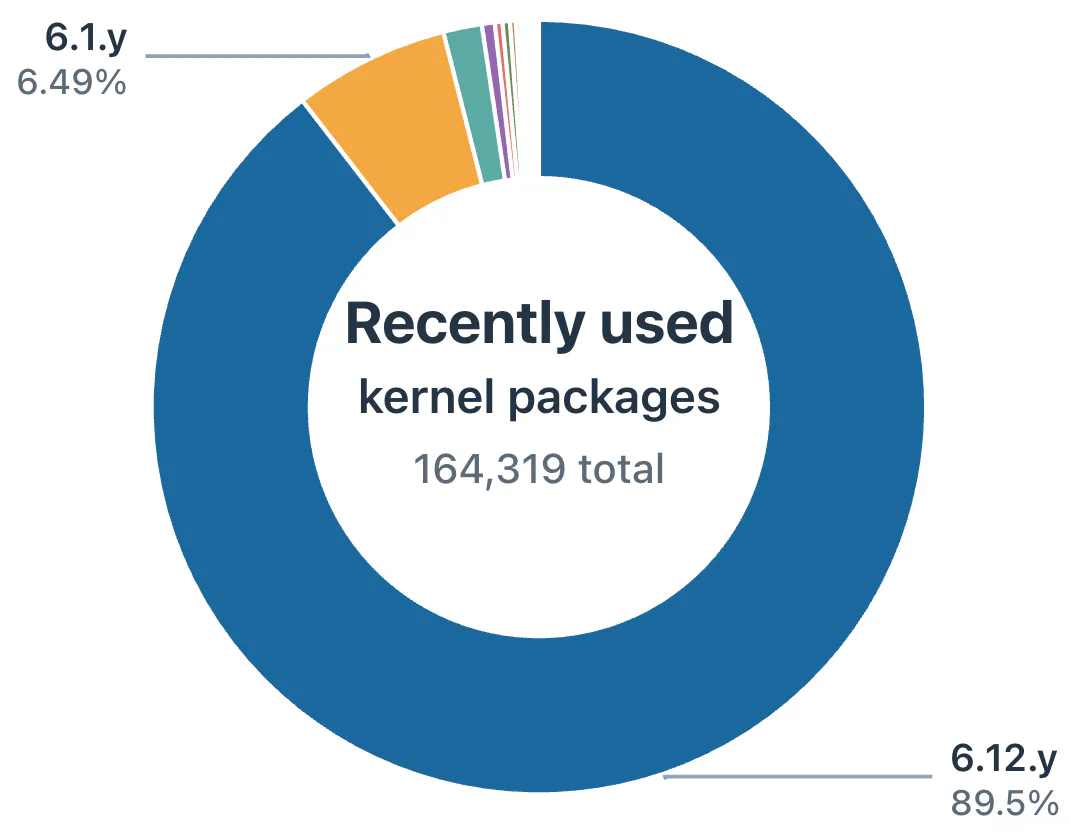
Users are faced with a decision: they can either stick with a stable, familiar version of software that has security flaws, or upgrade to a newer version that fixes those flaws but introduces other changes and new features they may not want.
Many people purposely do not update to new releases; I think this is entirely justified and normal end-user behavior. Just recently, I updated my Mac to macOS 27 and couldn’t use a printer that had worked flawlessly for years (until Codex wrote a new, compatible printer driver). Similar situations effectively require older software.
We should not have to make a choice between stability and security.
Thousands of known CVEs lack stable-branch fixes
A swarm of cyber-capable AI agents can cut through a network of stable, known-vulnerable software like a hot knife through butter. The scale of the problem is such that the software you are currently running likely contains unfixed security bugs that can be exploited by modern AI agents. As AI-assisted bug hunting makes it easier to identify vulnerabilities in older code, reducing this backlog becomes increasingly important. This is not merely theoretical. A fix for the latest high-profile bug, CVE-2026-98432 (a critical remotely exploitable flaw in the Linux TCP stack), still had not landed in distribution kernels weeks after being patched upstream. That bug is high-profile enough that it will soon be fixed everywhere. But fixes for more obscure bugs never get backported. I saw this during my sandbox escape research, and an old vulnerability in stable software was used as a part of the recently disclosed OpenAI hack.
Let’s quantify the scale of the missing backport problem. To make counting simple, we can limit ourselves to known bugs (with assigned CVEs) that are patched in the latest release but missing from stable packages. For this example, we’ll look at the Linux kernel, Ubuntu 26.04 LTS and Debian 13 Stable. I’m not singling out those projects—they are all run very well! I’m using them because they have documentation and accounting for unfixed CVEs. Other projects lack this transparency.
Let’s look at the number of outstanding CVEs in the Linux kernel, by stable branch. The table below shows CVEs per supported stable branch that do not have a fix in that branch, but do have it in a newer branch. (Hence, older branches by definition have more unfixed CVEs.) The source is the kernel CVE team’s vulns.git as of September 18, 2026. This is not an exact bug count, as it both over- and under-counts due to several technicalities. It is also not a measure of exploitability. Rather, it’s a measuring stick showing that a substantial amount of known CVEs have not been fixed in stable kernel branches:
| Branch | Unfixed CVEs | % CVEs with an NVD Score | High or Critical Severity |
|---|---|---|---|
| 5.10.y | 2,006 | 55.8% | 213 (19.0%) |
| 5.15.y | 1,889 | 51.5% | 195 (20.0%) |
| 6.1.y | 1,329 | 43.9% | 99 (17.0%) |
| 6.6.y | 1,012 | 35.6% | 65 (18.1%) |
| 6.12.y | 686 | 22.3% | 21 (13.7%) |
| 6.18.y | 337 | 15.1% | 3 (5.9%) |
The package landscape is not any better. These are non-kernel CVEs reported as open or affected in Debian 13 and Ubuntu 26.04 (raw data via their respective bulk CVE data feeds, compiled by Codex). These are distro-metadata findings, not individually source-confirmed vulnerabilities. Again, this is not meant to be an exact bug count, but more of a measuring stick indicating how many unfixed vulnerabilities remain in stable software packages:
| Distribution | Source Packages with Unfixed CVEs | Unique CVEs | High or Critical Severity |
|---|---|---|---|
| Debian 13 | 1,128 | 4,562 | 1,822 (39.9%) |
| Ubuntu 26.04 | 1,028 | 770 | 335 (43.5%) |
Engineers and AI can accelerate backporting
We realized this was an issue and have been fixing it proactively. First, we started with the equivalent of finding money on the sidewalk: there are bug fixes to known CVEs that apply cleanly to the stable kernel trees, but the fix was just never pulled into the kernel. We used Codex with GPT-5.6 to find these fixes, and asked the maintainers to apply the existing patches. They did, graciously. We then moved on to backporting patches that don’t apply as-is, starting with the most trivial to validate and review, and are slowly moving towards more complex changes. So far 149 CVE fixes in stable trees are currently applied; the list on our backport tracker just keeps growing.
We’ve done the same for Linux distributions: we used Codex and GPT-5.6 to identify known vulnerabilities in shipping stable packages, and then backport and validate a fix. We have begun reaching out to Linux distributions with an initial batch of patches.
If you run an open-source project or a Linux distribution and would like help backporting security fixes, please apply at trailofbits.com/patch-the-planet and we’ll be glad to assist.
The big upside of stable software that does not add features is that we can, in theory, fix bugs before attackers exploit them. So, let’s continue to patch the planet!