cat -- '2026-09-16-security.md' Security News
Nebelwelt
Security research and insights
CrossFit: Demystifying VM Callback Bugs - September 16, 2026
Scripting languages are an essential part of many software environments. Common languages like Python, Ruby, or PHP power large parts of the modern web but bugs in their runtime environments allow attackers to break memory safety and sandboxing guarantees. A common bug class is callback bugs which happen when user-defined …
SecurityWeek
Latest cybersecurity news
Enterprises Warned of Attacks Exploiting WSO2 Vulnerability - September 16, 2026
The vulnerability, tracked as CVE-2026-5430, can be exploited to gain access to valuable enterprise data.
The post Enterprises Warned of Attacks Exploiting WSO2 Vulnerability appeared first on SecurityWeek.
Oracle Patches 800+ Vulnerabilities in September 2026 Security Update - September 16, 2026
The security updates resolve over 800 vulnerabilities across 17 product families, including over 100 critical-severity flaws.
The post Oracle Patches 800+ Vulnerabilities in September 2026 Security Update appeared first on SecurityWeek.
The Hacker News
Cybersecurity news and insights
Attackers Exploit WooCommerce Wholesale Lead Capture Flaw to Plant PHP Web Shells - September 16, 2026
Threat actors are exploiting a critical security flaw in WooCommerce Wholesale Lead Capture, a premium WordPress plugin that has more than 6,000 active installs.
“This vulnerability can be leveraged by unauthenticated attackers to upload arbitrary files, including PHP backdoors, and achieve remote code execution,” Wordfence said.
The WordPress security company said it has blocked over
Active Exploitation Attempts Target WSO2 API Manager JWT Bypass With Forged Admin Tokens - September 16, 2026
A critical security flaw in WSO2 API Manager has come under active exploitation in the wild, according to findings from watchTowr.
The vulnerability, tracked as CVE-2026-5430 (CVSS score: 9.8/10.0), is a case of improper verification of a cryptographic signature that could result in account takeover. Hacktron Team has been credited with discovering and reporting the flaw.
“JWT authentication
SecurityWeek
Latest cybersecurity news
Microsoft Commits to Sweeping AI Privacy Rules for Students. Will Other Tech Giants Follow? - September 15, 2026
Microsoft agreed to adopt guardrails and privacy standards for its AI in schools, as negotiated with the American Federation of Teachers.
The post Microsoft Commits to Sweeping AI Privacy Rules for Students. Will Other Tech Giants Follow? appeared first on SecurityWeek.
The Hacker News
Cybersecurity news and insights
KREMLIN Banking Malware Hijacks Chrome and Edge to Steal Credentials and Session Tokens - September 15, 2026
Cybersecurity researchers have shed light on a previously undocumented Brazilian banking malware operation that delivers a toolkit called KREMLIN.
Elastic Security Labs is tracking the activity under the moniker REF9334. Active since at least May 2025, the threat actor has used lures that impersonate a dozen Brazilian banks and install a malicious browser extension on Google Chrome and
Iranian Hackers Use Telegram-Controlled Malware to Spy on Dissidents and Journalists - September 15, 2026
Cybersecurity agencies in the United States, the United Kingdom, and the Netherlands have detailed a Windows malware that they say Iran’s intelligence service uses to spy on dissidents, journalists, and activists around the world.
The malware is controlled via the Telegram messaging app and can copy a target’s emails and chat messages, take screenshots, and activate the microphone to record
Nebelwelt
Security research and insights
PrivacyShield: Privacy-aware Tracking Protection - September 15, 2026
Trackers like Apple's FindMy devices have seen an incredible boom throughout the last few years and are used for a variety of use-cases such as tracking lost luggage, stolen bikes, or simply finding one's lost keys. But they may also be used by stalkers to track their victims. Our goal …
SecurityWeek
Latest cybersecurity news
$1 Million Sandbox Challenge Uncovers Linux Kernel Flaws - September 15, 2026
AI-assisted researchers flooded Vercel with reports, forcing the company to automate vulnerability triage.
The post $1 Million Sandbox Challenge Uncovers Linux Kernel Flaws appeared first on SecurityWeek.
Exein Secures $270M at $1.7B Valuation for Physical AI Security - September 15, 2026
The cybersecurity startup is building a proprietary foundation model and plans to accelerate global expansion.
The post Exein Secures $270M at $1.7B Valuation for Physical AI Security appeared first on SecurityWeek.
Texas Utility CenterPoint Energy Confirms Breach After Hacker Leaks Data - September 15, 2026
A hacker claims to have stolen 7.5 million customer records after breaching the company’s systems.
The post Texas Utility CenterPoint Energy Confirms Breach After Hacker Leaks Data appeared first on SecurityWeek.
The Hacker News
Cybersecurity news and insights
BambooToken Malware Uses MQTT to Control Windows and Linux Systems - September 15, 2026
Cybersecurity researchers have disclosed details of a multi-platform campaign that uses the Message Queueing Telemetry Transport (MQTT) protocol as a communication channel to control Windows and Linux systems.
The emerging malware family, codenamed BambooToken, is assessed to be active since at least February 2023 and put to use in attacks targeting organizations across Asia and South America.
SecurityWeek
Latest cybersecurity news
Thai Broadband Provider Hacked via Fortinet Vulnerability - September 15, 2026
The hackers staged numerous scripts for reconnaissance and CVE probing, along with brute-force utilities and privilege escalation tools.
The post Thai Broadband Provider Hacked via Fortinet Vulnerability appeared first on SecurityWeek.
OpenAI Investigates Report Linking AI Agents to RubyGems Attack - September 15, 2026
The incident occurred in May, when RubyGems maintainers suspended new account registrations due to what appeared like malicious activity.
The post OpenAI Investigates Report Linking AI Agents to RubyGems Attack appeared first on SecurityWeek.
The Hacker News
Cybersecurity news and insights
Human Attacker Exploits Marimo RCE, Reaches SSH Bastion in Eight Seconds - September 15, 2026
With artificial intelligence (AI) shrinking the window between vulnerability discovery and exploitation and lowering the barrier to entry for bad actors, new findings from Sysdig show that skilled human operators can move just as swiftly after gaining initial access.
In one instance highlighted by the cloud security company, the threat actor pivoted from a vulnerable Marimo notebook to an SSH
SecurityWeek
Latest cybersecurity news
240,000 Hit by Data Breach at Japan’s Digital Agency - September 15, 2026
Hackers exploited a vulnerability in a VPN product to steal the personal information of roughly 240,000 people.
The post 240,000 Hit by Data Breach at Japan’s Digital Agency appeared first on SecurityWeek.
The Hacker News
Cybersecurity news and insights
Attack Chains, Not Just Attack Surfaces: Why Testing Individual Techniques Misses the Point - September 15, 2026
Introduction
Security teams have gotten pretty good at testing against what can hurt them. Can this EDR agent catch this payload? Will my organization fail the phishing simulation? Does this SIEM rule fire on this particular technique? And, in more mature organizations, this testing happens continuously rather than as a one-off exercise.
But no matter how much you validate against these
Mass-Scanning Campaign Exploits Vite Flaw to Extract Cloud Credentials From Exposed Dev Servers - September 15, 2026
Cybersecurity researchers have disclosed details of a mass-scanning campaign that has targeted Vite deployments siphon sensitive data.
The first is an automated effort aimed at internet-exposed Vite development servers that’s designed to steal cloud credentials, configurations from Amazon Web Services (AWS) and Microsoft Azure instances, and infrastructure state files, per F5 Labs.
The
Schneier on Security
Security news and analysis by Bruce Schneier
25 Years of Mass Surveillance Is Enough - September 15, 2026
This essay was written with Cindy Cohn, and originally appeared in Lawfare.
One of the many legacies of the terrorist attacks of Sept. 11 is the government-wide shift from targeted surveillance—such as individual wiretaps or pen register/trap and trace orders—to mass surveillance techniques—such as tapping into the internet backbone or mass collection of telephone or internet metadata. The legal and technical architecture of modern mass surveillance, initially framed as a necessary defense against terrorist threats, has grown far beyond that justification and national security in general. Mass surveillance is now a routine tool used by law enforcement. ICE uses it in...
Trail of Bits Blog
Security research and insights from Trail of Bits
1Password’s AI patching benchmark is misleading - September 15, 2026
1Password’s FLAWED report, published on August 6, 2026, gives defenders a misleading picture of AI patching. Its headline says models produced clean fixes only 26% of the time. That figure includes experiments that deliberately instructed agents to apply the wrong fix, along with experiments in which agents could not compile or test their patches.
The report risks making defenders less effective by discouraging them from using technology that could help them fix more vulnerabilities. Teams that take its headline at face value may leave repairable vulnerabilities unaddressed.
We want our work to help defenders fix more vulnerabilities. This post shares real-world data on human and agent patch quality from our consulting projects and Patch the Planet. We’re also releasing two agent skills: post-patch-validation to help agents test fixes, and review-walkthrough to help engineers review them.
How the experiment produces a misleading headline
Our review of 1Password’s code and data found four choices that make its 26% clean-fix rate a misleading guide to ordinary patching work.1
- The sample was selected for difficult fixes. The authors chose six vulnerabilities because their fixes were complex. Clean-fix rates ranged from 3% to 60% across those bugs, so the average depends heavily on which vulnerabilities made the list.2
- Two prompts tell agents to apply the wrong fix. Those prompts account for 22% of the data. Combining them with ordinary repair attempts makes the reported rate depend partly on how often the researchers chose to give agents bad advice.
- More than a third of the trials prohibit testing. One evaluation mode prevents agents from building or running code and accounts for 36% of the data. The headline combines those trials with experiments in which agents could test their patches and act on the results.
- The models ran at different reasoning settings. GPT-5.5 ran at medium effort and Opus 4.8 at high. These were the tools’ defaults. Neither model was tested at its highest available setting, and the authors did not measure how increasing effort affected the results.
1Password’s headline also obscures a useful result in its own data. We reanalyzed the patches and recorded test results published with the study, keeping trials where agents could run code and were not instructed to apply the wrong fix. In those trials, 2,634 of 3,067 patches generated by 1Password’s models (86%) blocked the supplied exploit. We excluded runs that the study classified as having consulted the upstream fix. Blocking that exploit does not establish a complete repair, but these results show useful patching capability under reasonable working conditions that the headline fails to convey.
The instructions and grading introduce further problems, several of which Davi Ottenheimer has also highlighted:
- The stopping rule and grading criteria disagree. Agents given a proof-of-concept exploit were instructed to stop once their patch defeated it. The grader then evaluated vulnerable paths that the supplied exploit did not exercise.
- The grading penalizes intended behavior changes. Agents were told to leave existing tests untouched, even though a correct fix can require updating tests to reflect changed behavior. We found that 8% of ActiveMQ verdicts penalized an intended behavior change as a regression.
- The automated grades disagree with human review. Models grading their own patches matched human reviewers on the full five-category outcome in 65.9% of reviewed cases. Agreement was 87.7% for whether the original bug was fixed and 70.5% for whether new bugs were introduced. (Table 24)
- Changing the reviewer changes the result. The two models assigned different outcomes to 36.8% of the same patches. The headline averages their assessments. (Table 20)
- The Linux reference fix contains a vulnerability. The authors found 248 generated patches that repeated an off-by-one error in the upstream fix. The automated grader caught that new vulnerability in only 24 of them. (Section 4.4)
- The Chromium grader accepts incomplete repairs. It marked many patches as clean even though they left a use-after-free vulnerability in a callback. (Section 4.9)
The grading errors can penalize valid fixes and let vulnerable patches pass. Combined with the handpicked sample and deliberately bad instructions, they leave the report without a credible basis for its headline. Defenders should not take 1Password’s headline rate seriously as a measure of AI patching ability.
Developers get one in eight fixes wrong under ideal conditions
Understanding agent failures also requires understanding how often developers submit incomplete fixes. Our security consulting work gives us a detailed record of how developers repair vulnerabilities in their own software. We give clients detailed vulnerability reports, then conduct a “fix review” to check whether their proposed patches fully resolve the issues.
Our records connect each vulnerability to the developer’s first proposed fix and our assessment of whether it worked. They preserve unsuccessful attempts that developers revise before an issue is considered resolved.
We reviewed the first fixes submitted for 2,265 vulnerabilities across 236 Trail of Bits security assessments from 2024 to 2026. The developers maintained the affected software, had detailed reports from our engineers, and knew we would review their patches. Even under those favorable conditions, 283 first fixes failed to fully resolve the reported issue: 12.5%, or one in eight.
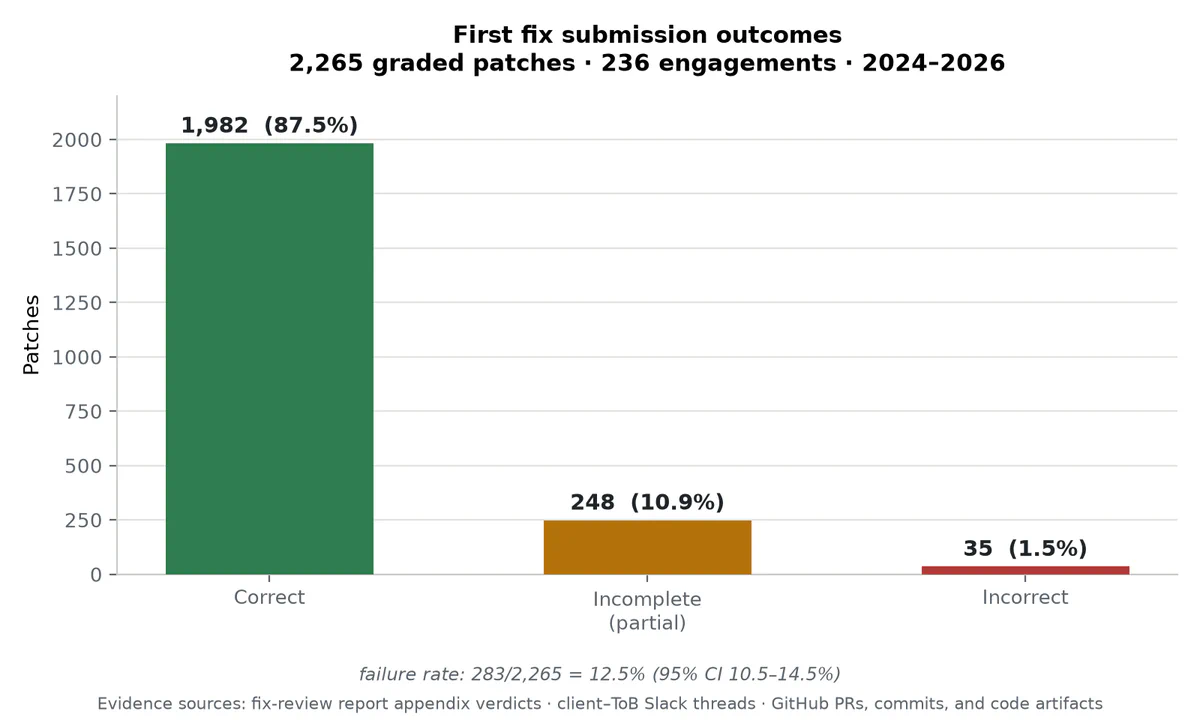
Accounting for multiple fixes from the same assessment, the 95% confidence interval is 10.5% to 14.5%. Sometimes we point out a mistake in a client’s patch during an informal conversation, and they correct it before the formal fix review. Those early failures may never appear in the review record, so our data can undercount failed first attempts. We also excluded cases where the available records did not establish whether the fix worked. A direct comparison with agents would require the same tasks and working conditions.
What happened to our patches in real projects
Through Patch the Planet, our joint initiative with OpenAI, Trail of Bits has co-authored hundreds of patches for widely used open-source projects. Agents wrote the patches with engineers directing the work and checking the results. Project maintainers then decided whether to merge, revise, or reject each submission.
How maintainers reviewed Patch the Planet patches
We examined the public review history of every Patch the Planet submission in our dataset that maintainers had merged or closed by September 14, 2026: 186 pull requests. 1Password’s benchmark used six vulnerabilities selected because their fixes were complex.
Maintainers merged 126 of our 186 pull requests, an acceptance rate of 67.7%.3 In 91 of those 126 pull requests (72.2%), maintainers accepted the security fix we originally proposed.
| Review outcome | PRs | % of merged PRs |
|---|---|---|
| Total merged | 126 | 100% |
| Accepted with no security-relevant revision observed | 91 | 72.2% |
| Accepted with security-relevant revision observed | 33 | 26.2% |
| Indeterminate | 2 | 1.6% |
Table 1: Changes requested by maintainers for 126 merged Patch the Planet pull requests. Security-related revisions include repairs to a proposed fix and expansions of its security coverage.
Maintainer acceptance does not establish that every patch is correct.
Maintainers closed the other 60 submissions without merging them. Most were superseded by other work or declined for policy, process, scope, or maintenance reasons. Four were explicitly rejected on technical grounds.
| Reason for closure | PRs | % of closed PRs |
|---|---|---|
| Total closed without merge | 60 | 100% |
| Superseded, reimplemented, or re-landed elsewhere | 36 | 60.0% |
| Policy, process, scope, or maintenance reasons | 14 | 23.3% |
| Duplicate or convergent with another fix | 3 | 5.0% |
| Explicitly rejected on technical grounds | 4 | 6.7% |
| Other or indeterminate | 3 | 5.0% |
Table 2: Reasons maintainers closed 60 Patch the Planet pull requests without merging
One of those closed submissions was our freenginx patch.
A maintainer and an agent introduced the same freenginx crash
1Password’s case study examines a Patch the Planet fix for a memory-safety bug in freenginx’s embedded Perl module. An agent wrote our patch under the direction of a Trail of Bits engineer. It left one vulnerable code path open and introduced a new crash during request cleanup. The paper’s criticism of our patch is correct.
The maintainer closed our pull request and committed a separate fix. That fix covered all three vulnerable code paths but introduced the same crash during cleanup. The paper documents the maintainer’s regression too.
Both authors encountered the same trap. The original bug allowed Perl to destroy a callback before freenginx used it.
Both fixes kept the callback alive so freenginx could use it later. But if the request timed out first, freenginx would make the request unusable and then release the callback. Releasing it could run Perl code that still tried to use the request, crashing the worker. Both authors missed a problem their fix could cause later, during cleanup. Catching it required looking beyond the original bug to what happened when a request ended early.
Two authors, one human and one agent, working separately, made the same mistake on the same bug. Readers deciding whether to use agents need to know how their failures compare with those of human developers. Establishing which is more reliable requires measuring both under comparable conditions.
We checked what happened after our patches were merged
We examined about 33,500 subsequent commits in Patch the Planet projects. When a later commit changed a file our patch had modified, we investigated whether it fixed a problem our patch had introduced. For each suspected regression, an agent attempted to demonstrate its impact with a proof of concept. Other agents and our engineers then challenged the findings.
The review found at least ten functional bugs; four build, test, or release automation bugs; and one performance bug. It found no exploitable security vulnerabilities. Two examples illustrate the problems we identified:
- In go-jose, PR #240 fixed a missing-header crash but exposed an existing validation gap, allowing encrypted messages to succeed even when their key length contradicted the declared algorithm. PR #266 added explicit key-length checks before decryption.
- In Noble FROST, PR #250 returned cached round-two results without first checking whether a retry contained the same authenticated transcript. Changed or stale retry data could therefore bypass that check. The maintainer corrected the behavior by validating retries against the original transcript before returning cached results.
We are extending this investigation to every patch we authored, including patches with maintainer contributions. The findings will help us add checks that catch these failures before we submit future patches.
Agent skills for better security patches
We are releasing two agent skills alongside this post: post-patch-validation to help agents test security fixes, and review-walkthrough to help engineers review code changes.
Post-patch-validation is a new skill we wrote to help agents catch incomplete fixes and regressions before submitting patches for review. It was not used in the Patch the Planet work described above.
The skill starts with a vulnerability report and the code before and after the patch. It guides the agent through four tasks:
- Reproduce the original bug. The agent writes a check that must fail on the vulnerable code and pass on the patched version. A test that passes on both revisions cannot demonstrate a fix.
- Test another path to the same failure. The skill requires at least one distinct variant based on the bug’s root cause, such as a different caller or a cleanup path.
- Check for regressions and new vulnerabilities. It compares behavior that should remain unchanged and tests security properties around the modified code. The plan must also include project tests, a sanitizer check, or a bounded fuzzing run.
- Treat broken test runs as inconclusive. A failed build or missing dependency must not be mistaken for evidence that a vulnerability was reproduced.
Failed checks give the agent specific problems to investigate and repair before submitting its patch. The skill saves the tests and results so maintainers can see what was checked.
To try post-patch-validation, install the skill and give your agent the vulnerability report and the vulnerable and patched revisions:
“Use post-patch-validation to validate the patch in HEAD against <vulnerable-commit>, using the vulnerability report in <report-path>.”
Review-walkthrough helps engineers review the patches they are responsible for merging. It turns a branch’s complete diff into an interactive walkthrough that explains the changes in a logical reading order. Review findings appear beside the relevant code, where engineers can inspect them and draft their own comments. The walkthrough can also prepare a GitHub review for submission. Follow the quick start to generate a walkthrough for your branch.
These releases join our other public agent skills for improving security patches:
- variant-analysis helps agents find related defects elsewhere in the codebase.
- property-based-testing helps them test behavior across generated inputs.
- mutation-testing helps them determine whether their tests detect incorrect behavior and identify missing assertions.
We publish these methods so other teams can use them to examine and improve their own patches.
What a useful patching benchmark should measure
A useful patching benchmark should measure whether agents help developers produce correct fixes and how much review those fixes require. The principles in our 2018 guide to evaluating fuzzing research apply here:
- Choose a sample that matches the research question. Explain how the sample was chosen and which repair work it represents. Difficult cases can expose failure modes. General failure rates require a representative sample.
- Measure the effects of working conditions. Give agents appropriate tools and instructions. Report model configurations and test how reasoning settings affect results. Report misleading prompts and restricted tool access separately.
- Make correctness verifiable. Check that patches fix the vulnerability beyond the supplied exploit. Test for security, functional, and performance regressions. Validate grades against expert review and publish the tests, configurations, and results.
- Show how results vary. Report per-vulnerability outcomes and variation across repeated attempts. Repeating trials on the same bugs cannot establish that those bugs represent everyday patching.
- Measure what agents contribute to the repair process. Compare developers working with and without agents on comparable tasks and under comparable conditions. Measure initial patch quality and the review and revision needed to reach a correct fix.
We are optimistic about AI’s usefulness to defenders. Through Patch the Planet, we are committing engineering time to fixing vulnerabilities alongside the people who maintain the affected software. We examine failures so we can improve our methods.
We will keep putting agents to work on difficult security problems and making the tools and lessons public. We want other teams to test our conclusions and take these methods further. Our goal is to give maintainers without dedicated security teams the ability to find and fix vulnerabilities that would otherwise go unaddressed.
-
The paper defines a clean fix as fully resolving the vulnerability without materially changing application behavior. ↩︎
-
The six-target mean has a standard error of about nine percentage points, which the report does not disclose. ↩︎
-
As of September 14, 2026, our dataset contained 240 public upstream pull requests. We excluded the 54 submissions still open from the outcome analysis. We count pull requests, each of which can contain more than one patch, and exclude maintainer-written replacements from our merged total. ↩︎
The Hacker News
Cybersecurity news and insights
LiteSpeed Enterprise Flaw Could Let One Hosting Account Gain Root Access on a Shared Server - September 15, 2026
A critical vulnerability in LiteSpeed Web Server Enterprise could let a low-privilege website user gain root access on a shared-hosting server, cPanel warned in an advisory published on September 14.
On such servers, many customers’ sites run on a single machine, and an attacker with one of those hosting accounts could exploit the flaw to access or alter other sites and the server itself,
Cisco Secure Email Gateway Flaw Exploited in the Wild, Enables Root Command Execution - September 15, 2026
Cisco has warned that a new critical vulnerability impacting AsyncOS Software for Cisco Secure Email Gateway has come under active exploitation in the wild.
The vulnerability, tracked as CVE-2026-76461, carries a CVSS score of 9.8 out of a maximum of 10.0. It has been described as a case of insufficient validation in the email parsing logic that could allow an unauthenticated, remote attacker
Nebelwelt
Security research and insights
Exploiting Android Apps with Counterfeit Art - September 15, 2026
Arbitrary file overwrite vulnerabilities are, unfortunately, quite common in Android apps. Often the adversary can control some part of the path to partially or fully overwrite files in the file system of the application. The attacker thereby has the power to modify any file writable by the application. The attacker …
Schneier on Security
Security news and analysis by Bruce Schneier
Using AI for Weapons Development - September 14, 2026
Last week, Anthropic released a long and detailed document describing current misuses of their Claude models. I’m still reading it, but I wanted to flag this:
We identified a cell of threat actors based in northern Yemen running three weapons development programs: a guided rocket that used a commodity phone-class flight computer with final-phase homing guidance; a multi-stage ballistic missile with a stated range goal above 2,000 km; and a multi-variant missile (referred to as the “R2000” set) that included a hypersonic glide vehicle variant...
Microsoft’s Patching - September 14, 2026
Once a month, Microsoft pushes a security update to all Windows users. Tomorrow’s is a new record:
Microsoft’s patch for September is a doozy, with a record number of roughly 972 vulnerabilities fixed and 112 of them meeting the high critical-severity threshold.
It was only two months ago that Microsoft patched a then-record 570 vulnerabilities. Then, last month, Microsoft patched some 620 of them. Google and other companies have also published record numbers of vulnerabilities in recent months. Two weeks ago, OpenAI, Anthropic, Amazon Web Services, Google, Microsoft, and 100 companies and organizations published an ...