cat -- '2026-09-19-security.md' Security News
The Hacker News
Cybersecurity news and insights
Critical Pre-Auth RCE in Orkes Conductor Workflow Platform Exploited in the Wild - September 19, 2026
A critical vulnerability impacting Orkes Conductor is being actively exploited in the wild, according to Fortinet.
The vulnerability in question is CVE-2026-58138 (CVSS v3.1 score: 9.8/CVSS v4 score: 9.3), which relates to a case of unauthenticated remote code execution.
“Orkes Conductor 3.21.21 before 3.30.2 contains an unauthenticated remote code execution vulnerability that allows remote
Google Gemini Broke Into Real Company Systems After Security Test Domain Mix-Up - September 19, 2026
Google’s Gemini model has become the latest artificial intelligence (AI) system to access the internet and break into other companies during a cybersecurity evaluation. The development was first reported by The Wall Street Journal.
The incidents occurred in May 2026 as part of a test run conducted by Israeli company Irregular. The evaluation partner was also involved in similar hacks disclosed
CrowdSec Says TanStack npm Attack Led to Copy of 170 Private GitHub Repositories - September 19, 2026
An attacker copied about 170 of CrowdSec’s private GitHub repositories on May 22 using the account of an employee who had just left, CrowdSec said on September 18.
The French security company had kept his GitHub access open. CrowdSec says his laptop was compromised in May’s supply chain attack on TanStack, in which malicious versions of TanStack’s npm packages stole credentials from
CISA Flags Three Linux Kernel Vulnerabilities Exploited in the Wild - September 19, 2026
The U.S. Cybersecurity and Infrastructure Security Agency (CISA) on Friday added three security flaws impacting the Linux kernel to its Known Exploited Vulnerabilities (KEV) catalog, citing evidence of active exploitation.
The vulnerabilities are listed below -
CVE-2025-39682 (CVSS score: 9.8) - An improper check for unusual or exceptional conditions vulnerability in the TLS receive path
Public Exploits Released for Four Linux Kernel Flaws That Enable Local Root - September 18, 2026
A security researcher has released working exploit code for four Linux kernel flaws that each let a local user gain root, the highest level of access on a machine.
Kernel maintainers have fixed all four over the past few weeks, so a system running an up-to-date kernel is not affected. But the exploit code is now public, and any machine still running an older kernel should be updated.
The flaws
New WordPress Click2Shell Flaw Forces Theme Installs, Can Chain to Code Execution - September 18, 2026
WordPress today released patches to fix a new set of vulnerabilities in its core software, one of which could allow a crafted web link, opened by a logged-in administrator, to install a theme from the official WordPress.org directory without anyone clicking Install.
The security firm pwn.ai, whose researchers reported the flaw, calls the attack chain Click2Shell. On its own the flaw only
Transparent Tribe Deploys New Rust Backdoor Using Private GitHub Repositories for C2 - September 18, 2026
The Pakistan-aligned threat group tracked as Transparent Tribe (aka APT36 and Earth Karkaddan) has been attributed to a fresh set of cyber attacks targeting government and defense entities in India and Afghanistan.
The attacks, per Zscaler ThreatLabz, involve the use of previously undocumented tools called RUSTYSHADE, RUSTYMOVE, PSNATCH, and BASHNATCH. The activity has been codenamed Operation
SecurityWeek
Latest cybersecurity news
In Other News: Ransomware Developer Sentenced, Plugin4Shell AI Attack, Critical SAP Flaw - September 18, 2026
Noteworthy stories that might have slipped under the radar: Mandiant's 2026 AI risk report, PhantomRaven malware used by bug bounty hunter, WordPress plugin bug exploited.
The post In Other News: Ransomware Developer Sentenced, Plugin4Shell AI Attack, Critical SAP Flaw appeared first on SecurityWeek.
The Hacker News
Cybersecurity news and insights
Microsoft Patches CVSS 10.0 Azure AI Foundry Flaw Enabling Unauthorized Privilege Escalation - September 18, 2026
Microsoft has released fixes for a maximum-severity security flaw in Azure AI Foundry that could be exploited to achieve privilege escalation. No customer action is required.
The vulnerability, tracked as CVE-2026-85889, carries a CVSS score of 10.0.
“Missing authentication for critical function in Azure AI Foundry allows an unauthorized attacker to elevate privileges over a network,“
SecurityWeek
Latest cybersecurity news
AI-Built Exploit and Sign-In Flaw Opened Path to Internal OpenAI Code - September 18, 2026
Hacktron researchers earned a bug bounty after demonstrating access to OpenAI employee accounts.
The post AI-Built Exploit and Sign-In Flaw Opened Path to Internal OpenAI Code appeared first on SecurityWeek.
23 Million User Records Compromised in Gyazo Data Breach - September 18, 2026
Gyazo maker Helpfeel said the attacker exploited a vulnerability in its image upload server to gain unauthorized access.
The post 23 Million User Records Compromised in Gyazo Data Breach appeared first on SecurityWeek.
Schneier on Security
Security news and analysis by Bruce Schneier
Are AIs Still Struggling with CAPTCHAs? - September 18, 2026
Anthropic’s recent security-incident document contains a bit about how CAPTCHAs are still frustrating Claude.
In the transcript, the Claude model that is so powerful that Anthropic is gatekeeping access to it appeared to slam its virtual head against the wall solving a simple image identification test. In a test where the agent was asked to identify a shape that didn’t match the others displayed, it couldn’t even decide which image to select. Instead, it repeatedly went over the same images and questioned its own conclusions.
“Actually hmm, wait,” it said in its chain-of-thought transcript, later adding “Ugh,” because we’ve decided that we need to inject human mannerisms into these machines for some reason. The whole thing took so long that the agent eventually realized that the challenge had expired and it would have to start the process again...
The Hacker News
Cybersecurity news and insights
An Abandoned CDN Domain Was Re-Registered. Thousands of Sites Still Call It. - September 18, 2026
In July 2025, someone registered a domain that used to belong to a content delivery network. The CDN had been wound down years earlier, and the domain it served assets from was allowed to expire. What it had not lost were its callers. Thousands of websites, code repositories, and documentation pages still carry hard-coded references to hostnames beneath it.
The new owner holds
Plugin4Shell Lets Repository Owners Swap Pinned Plugin Code Across Four AI Coding Agents - September 18, 2026
A flaw in four widely used AI coding agents lets someone who controls a plugin’s code repository swap the plugin an agent installs for a malicious one, even when the agent locked that plugin to a specific reviewed version, security firm Air Security said on Thursday.
The firm said Anthropic has patched the flaw in Claude Code 2.1.179 and OpenAI in Codex 0.146.0, that GitHub Copilot has no
Trail of Bits Blog
Security research and insights from Trail of Bits
Auditing in the age of (good enough) AI - September 18, 2026
Security firms have published numerous blog posts describing how they pointed their agent harness at a codebase and found dozens of bugs (we’re one of them). However, these posts tend to focus on agentic code review, which is just one aspect of how we use AI in our security reviews. We want to give a different perspective: before code review even starts, agents now allow us to build custom tooling and formal models that improve the quality and depth of our reviews.
We recently reviewed the Miden VM, a new zero-knowledge VM with its own custom assembly language and almost no developer tooling. To prepare, we spent six months having our agents build an LSP server, a decompiler, a static analysis engine, and a Lean model of the VM executor from scratch. These tools found real security issues, like an unvalidated prover-supplied input that would let a malicious prover forge Falcon signatures and steal funds from Miden account holders. Additionally, the Lean work produced 95 machine-checked correctness proofs, covering a large component of the Miden core library.
Auditing the Miden zkVM
In late 2025, the Miden team came to us to have parts of their zero-knowledge VM reviewed before launch. Part of the review was scoped to cover the Miden core library, which contains a small set of cryptographic primitives written in a custom assembly language called Miden assembly (MASM). This made us genuinely excited, as it was right up our alley: a high-assurance project writing complex cryptographic code in a low-level custom assembly language that we had never seen before. At the same time, it also presented some unique challenges.
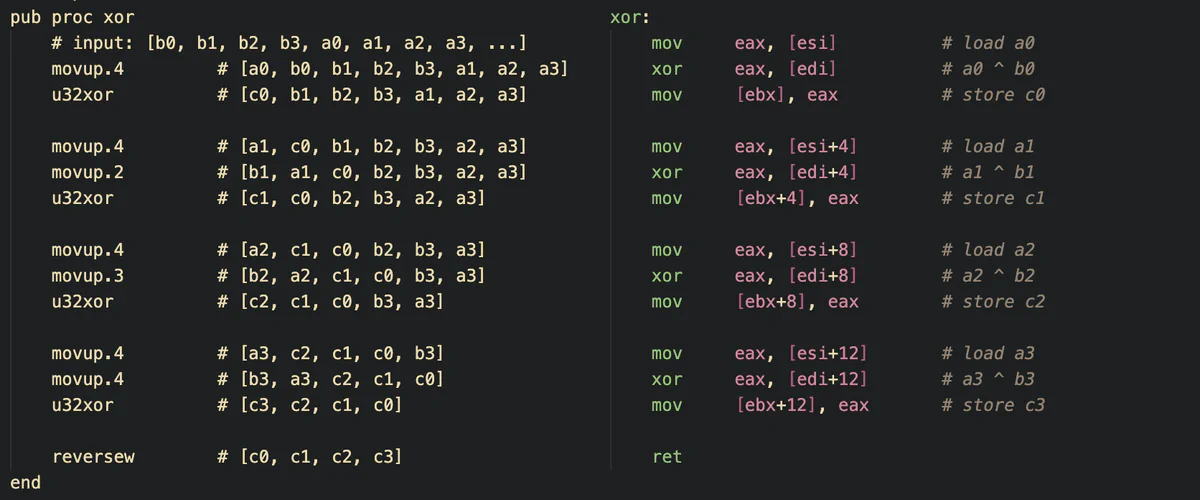
To start, the Miden VM implements a stack-machine architecture. This means that each instruction operates on values read from the stack, and the result of the instruction is then written back to the top of the stack. While conceptually simple, this makes code written in MASM challenging to review, since instruction inputs and outputs are read from the stack and are always implicit. Additionally, since the Miden VM is a completely new architecture, very little existed in terms of developer tooling like IDE support, Language Server Protocol (LSP) servers, and linters.
We knew that we had six months to prepare for the review, since the implementation was not yet feature complete, so we asked ourselves: “What could we spend our time and tokens on to make sure that the review would root out as many bugs as possible in the codebase?”
Building all the tools!
Since MASM lacked developer tooling, we started out by asking ourselves what kind of tools we would like to have available when the project started. We typically use VS Code to review code, and syntax highlighting and code navigation are essential for readability and being able to follow data flow throughout a codebase. We needed an LSP server and a corresponding VS Code extension for this, and within a few days we had Claude build a working prototype that provided most of the functionality we wanted: features like syntax highlighting, goto definition, finding code references, and displaying procedure docstrings on hover. With these fundamental features in place, we also decided to add more language-specific features like displaying inline instruction documentation, and stack effects for individual instructions.
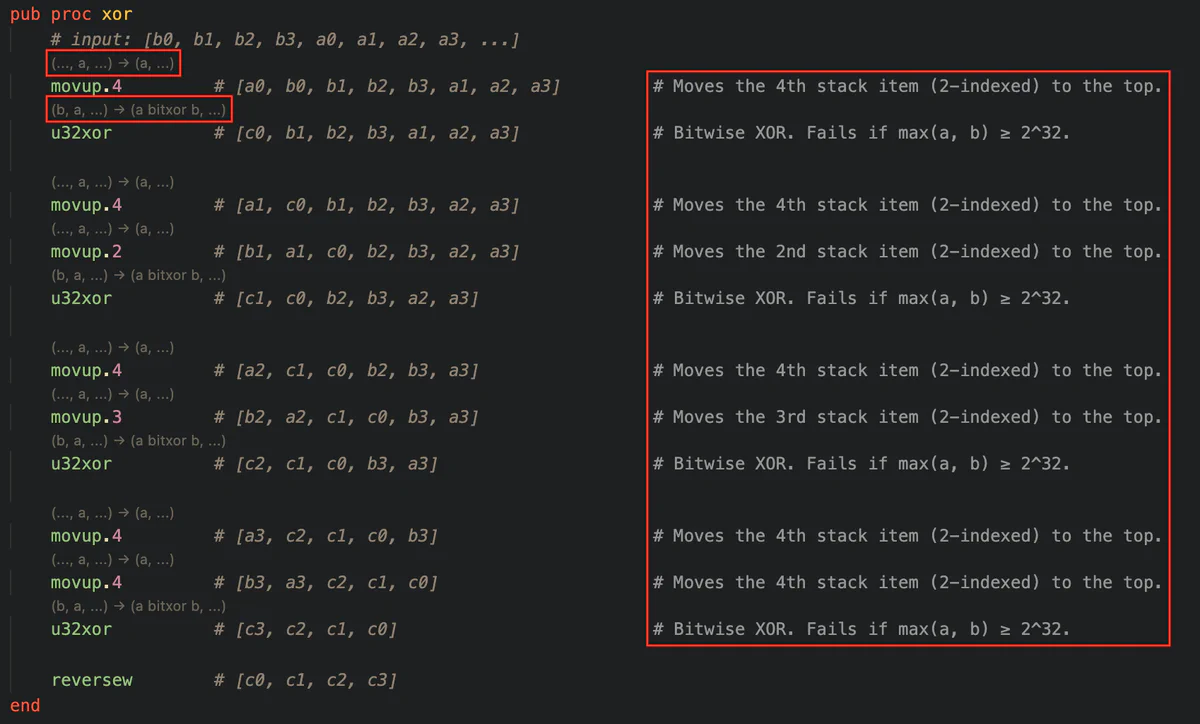
Having built the LSP server, we started thinking about other ways to provide high-level semantic information to support manual and agent-driven review. We thought it would be interesting to see if we could provide faithful decompilation for MASM procedures inside the VS Code UI, to help the reviewer quickly understand the high-level control flow and data flow of the procedures they were looking at. For MASM, this is a harder problem than it first appears. Stack machine lifting and decompilation is a well-studied problem, but decompiling hand-written MASM is still difficult for a number of reasons.
-
Most procedures in the core library do not have declared signatures, which means that the number of inputs and outputs must be inferred from context.
-
MASM procedures do not conform to a well-defined calling convention, and the net stack effect of such calls is generally impossible to determine statically. This means that all analysis failures propagate up the call chain.
-
While-loops do not need to be stack neutral, which means that the while-loop condition may occupy a different stack slot in each iteration. This also makes it impossible to map instruction inputs to stack slots for subsequent instructions.
-
Different branches in conditional statements may have different stack effects, which similarly makes stack tracking and signature inference challenging.
This meant that we could not expect to be able to decompile all MASM procedures if we also wanted the decompiled output to be correct. We therefore focused on decompiling a well-defined subset of MASM correctly. During the development of the decompiler, we alternated between using Claude for planning and development and Codex for code review. Whenever we had implemented a new feature, we had agents decompile a randomized set of procedures from the core library and compare the result to the original MASM to look for regressions. Any issues found were added as regression tests to be fixed by the model.
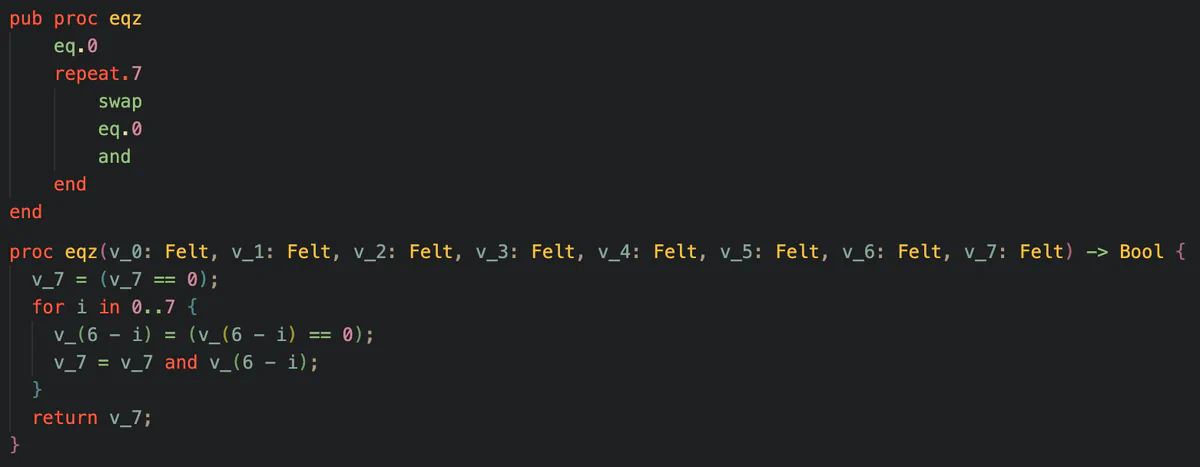
eqz procedure, which tests if a 256-bit integer (represented as eight 32-bit limbs) is equal to zero, together with the corresponding decompiled pseudocodeThe decompiler represented the single largest effort of the tooling development for this project, with over 100 AI-generated commits over multiple months. The main benefit of this work turned out to be the decompiler’s internal analysis frameworks and intermediate representation, which we could reuse for static analysis, rather than the full decompilation pipeline.
With the decompiler in place, we had access to an intermediate representation of each procedure, with instruction inputs and outputs populated as expressions. This allowed us to bring all the standard static analysis machinery (like data flow analysis) to bear on the problem of finding bugs in the MASM code. We used this to build a number of analysis passes over the intermediate representation, answering questions like the following:
-
Are prover-supplied advice values1 like remainders and modular inverses properly validated?
-
Are type constraints (e.g. an input being a 32-bit integer or a boolean) enforced?
-
Are local variables initialized across all execution paths?
One way to explore these issues is abstract interpretation. The idea behind this technique is simple. Instead of running the program with real numbers, the analysis tracks the types of values that could be on the stack at each step, like “a 32-bit integer” or “unknown.” It walks through the code again and again until no new information is found. Since it always keeps track of every possible value (with a little extra room), it can never miss a real case. So if a check passes in the analysis, it is guaranteed to hold in every actual run of the program.
We used Claude and Codex to build a general abstract interpretation engine, and then implemented a number of concrete analysis passes on top of it, having the agents switch between development and code review as described above. We also decided to have the agents design and build command-line interfaces for both the decompiler and a new MASM linter to make the new tools available to agent-driven code-review workflows as well.
Finding all the bugs!
During the actual review, these analyses identified over 400 unique locations2 where type validation could be improved (all of them reachable from the public API of the library) as well as one high-severity finding.
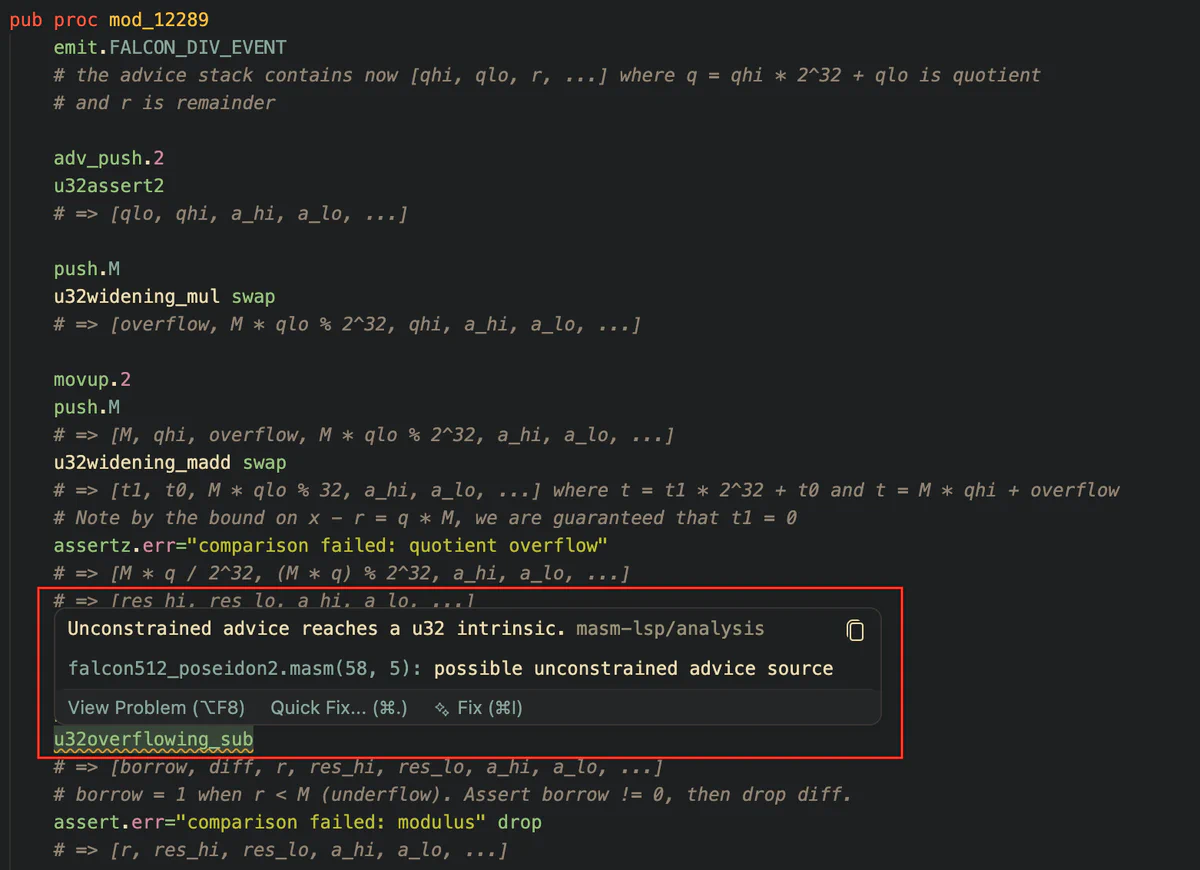
The high-severity issue was due to an underconstrained advice value in the mod_12289 procedure, which reduces a 64-bit value modulo 12289, with a quotient and remainder provided as advice values by the prover. The quotient is checked to ensure that it is a valid 64-bit value (represented as two 32-bit limbs), but the remainder is never validated before it is passed to the 32-bit instruction u32overflowing_sub. By carefully varying the quotient and remainder to ensure they still satisfy the constraints imposed by the subtraction, we found that it was possible to have mod_12289 return a value that is not the correct remainder. A malicious prover could exploit this to forge Falcon signatures and drain any Miden account controlled by a Falcon key pair.
But what if there are no bugs?
All this work meant that we had a comprehensive set of tools to support both manual and agent-driven code review coming into the audit. However, we’d had a long time to think about other ways to support the manual review process, and we had more ideas that we wanted to test. For example, if the procedures in the core library were implemented correctly and did not contain bugs, would it be possible to prove this using a proof assistant like Lean?
It turns out that the Miden VM is very amenable to formal modeling, since the instruction set is small and most instructions are side-effect free. To formally model MASM, we started by implementing a minimal Miden VM executor in Lean, and had Claude build an automatic translator from MASM procedures to Lean. During the review, we had multiple agents working in parallel to prove correctness of as many procedures as possible across the library. Since the Lean kernel could validate that the generated proofs were correct, we only needed to manually audit the theorem statements to ensure that each theorem proved the right correctness property for the corresponding procedure. To ensure that the theorems were easy to review, we introduced Lean types for field elements and the integer types implemented in the core library. This meant that at a high level, most correctness properties could be expressed in the following form:
If the stack is given by
[x1, x2, x3, ..., xn, ...]and we execute the procedureP, thenPterminates and the stack is given by[P(x1, x2, x3, ..., xn), ...].
P with n argumentsOur agent-driven formal modeling efforts resulted in 95 correctness proofs that covered all of the binary arithmetic components of the core library. This work also identified two subtle bugs that the existing unit test suite did not catch. The first was an edge case in the 64-bit right-rotation rotr, which behaved incorrectly on large inputs greater than the Goldilocks prime if the rotational shift was a multiple of 32. The second was an issue in the 256-bit multiplication wrapping_mul, which dropped caller-owned values from the stack before returning.

rotr procedure required an additional assumption (that shift mod 32 ≠ 0) to allow the proof to go through.Why we couldn’t have done this two years ago
The tools we developed leading up to this engagement, and the Lean libraries and proofs generated during the review, are all side projects that we wouldn’t have been able to dedicate time or resources to just one or two years ago. Projects like these are often highly exploratory in nature, and the end results and potential payoff may be difficult to predict. In practice, this means that it is hard to sell clients on them in advance. However, over the last year, agents became good enough to carry non-essential projects like these with only light supervision, which completely changed the economics of which projects are worth pursuing. Today, a failed side project only costs tokens.
With Miden, the benefits of all this preparatory work were clear. The LSP server and static analysis engine improved our manual review coverage, strengthened agent-driven reviews, and identified real security issues in the codebase that could have led to millions of dollars in lost funds. The AI-generated Lean correctness proofs also improved assurance across a large and fundamental component of the library, allowing the team to continue building on it with confidence. The team has adopted the static analysis engine developed for the review, which means that our side project will now also help secure future updates to the Miden core library.
On a personal note, this has been one of the more interesting projects I have worked on during my years at Trail of Bits. If you find this type of work interesting, or if you are building something similar, get in touch. We want to hear about it!
-
These are precomputed inputs that are supplied via a separate advice stack by the prover, and need to be validated carefully. ↩︎
-
Most of these findings were due to the fact that almost all procedures in the core library were part of the public API, which meant that third-party developers could call them without proper validation. ↩︎
SecurityWeek
Latest cybersecurity news
Microsoft Patches 18 Vulnerabilities in AI, Cloud Products - September 18, 2026
Microsoft fixed vulnerabilities across Azure and AI-branded products, with privilege escalation flaws accounting for the majority.
The post Microsoft Patches 18 Vulnerabilities in AI, Cloud Products appeared first on SecurityWeek.
Brevo Supply Chain Attack Injects Malware Into 100,000 Websites - September 18, 2026
Hackers used a compromised API key to deploy a Cloudflare worker that injected malicious scripts.
The post Brevo Supply Chain Attack Injects Malware Into 100,000 Websites appeared first on SecurityWeek.
Critical Orkes Conductor Vulnerability Exploited in Attacks - September 18, 2026
CVE-2026-58138 is an unauthenticated remote code execution vulnerability that attackers can exploit via inline workflow definitions.
The post Critical Orkes Conductor Vulnerability Exploited in Attacks appeared first on SecurityWeek.
MIND Secures $72 Million for AI-Powered DLP - September 18, 2026
The company will use the funding to accelerate platform development and expand its presence in key enterprise markets.
The post MIND Secures $72 Million for AI-Powered DLP appeared first on SecurityWeek.
Check Point, Kaspersky, Tanium Patch Product Vulnerabilities - September 18, 2026
Check Point Security Management and Log Servers are affected by a critical vulnerability that can allow remote code execution with root privileges.
The post Check Point, Kaspersky, Tanium Patch Product Vulnerabilities appeared first on SecurityWeek.
Cyberattacks on Two Oil Tankers Prompt Coast Guard, FBI to Board Vessels - September 17, 2026
The Coast Guard confirmed evidence of malicious cyber activity on the VL Prosperity, but has not attributed the attack to Iran.
The post Cyberattacks on Two Oil Tankers Prompt Coast Guard, FBI to Board Vessels appeared first on SecurityWeek.
Nebelwelt
Security research and insights
x402 or How to Race Against the Blockchain - September 17, 2026
x402 is a rising payment protocol that enables micropayments for web services. Building on top of HTTP, x402 is an extension that allows, e.g., LLM agents to pay for any requests that they make. x402 is backed by a blockchain infrastructure where payments are validated and settled. We discovered …
VulGenie: Mining Security Patches to Find API Violation Bugs - September 17, 2026
As we move to memory safe language, pointer arithmetic no longer is the main source of bugs, instead API misuse becomes a key issue. Complex code is hidden behind API abstractions and developers may make mistakes in how they use these APIs. While API mining has been an active field …
Schneier on Security
Security news and analysis by Bruce Schneier
How Candidates Could Use AI for Good - September 17, 2026
This essay was written with Nathan E. Sanders, and originally appeared in The Guardian.
There are plenty of signs that AI will make all of our experiences of the US midterm elections worse. Voters have anxiety about AI’s impacts on the country. Politicos are using AI deepfakes to spread lies. The White House is posting slopaganda.
Meanwhile, candidates are missing a real opportunity to use AI to make campaigning better. The technology can help candidates listen more deeply to voters’ concerns, engage constituents more inclusively, and formulate policy platforms that are more responsive to our input. There are vanishingly few examples of this in ...
Fake CAPTCHA Scams - September 16, 2026
New variant of an old scam: Use the framing of a CAPTCHA to get an unsuspecting user to download and run a malicious program.